
HSK word lists: which one you need, and what to do with it
2026-09-05 · 5 min read
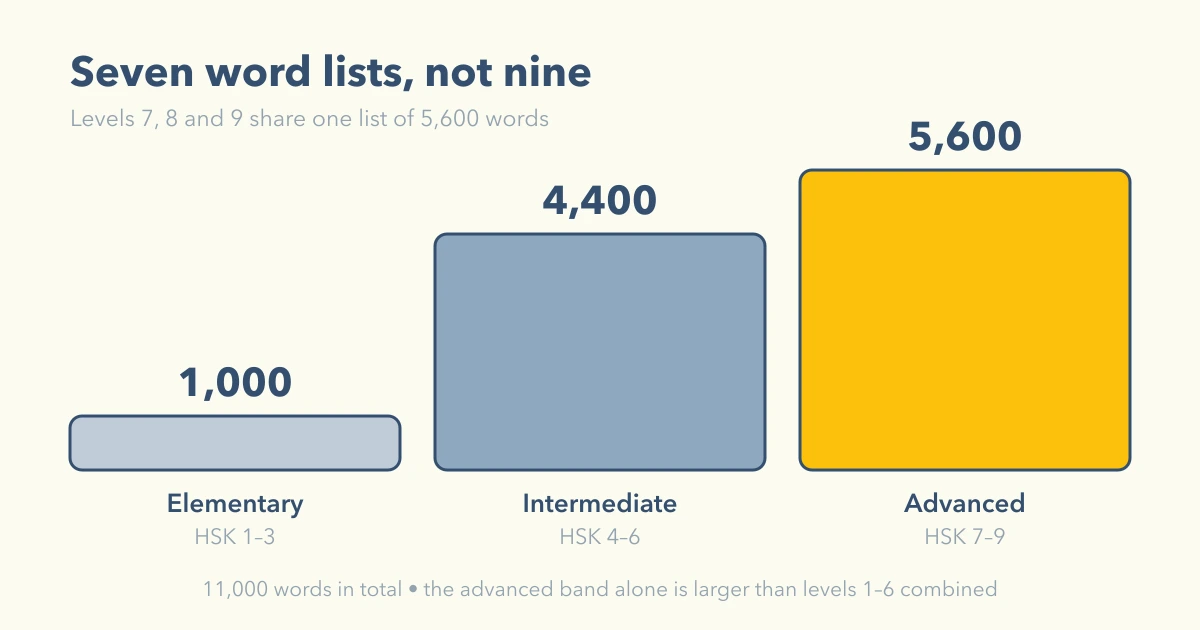
There are seven HSK 3.0 word lists, not nine. Levels 7, 8 and 9 share a single list of 5,600 words — the standard defines the band, not three separate vocabularies inside it. That one fact saves a lot of fruitless searching for "the HSK 8 word list".
Here is what each one contains, and where to read it:
| List | New words | Running total |
|---|---|---|
| HSK 1 | 300 | 300 |
| HSK 2 | 200 | 500 |
| HSK 3 | 500 | 1,000 |
| HSK 4 | 1,000 | 2,000 |
| HSK 5 | 1,600 | 3,600 |
| HSK 6 | 1,800 | 5,400 |
| HSK 7–9 | 5,600 | 11,000 |
Two things are worth noticing before you pick one. HSK 2 is smaller than HSK 1 — the only place in the sequence where a level asks for less than the one before it. And the advanced band on its own is larger than levels 1 through 6 put together.
The lists are not the same kind of list
Count how many characters each entry has and the seven lists stop looking like one thing at seven sizes.
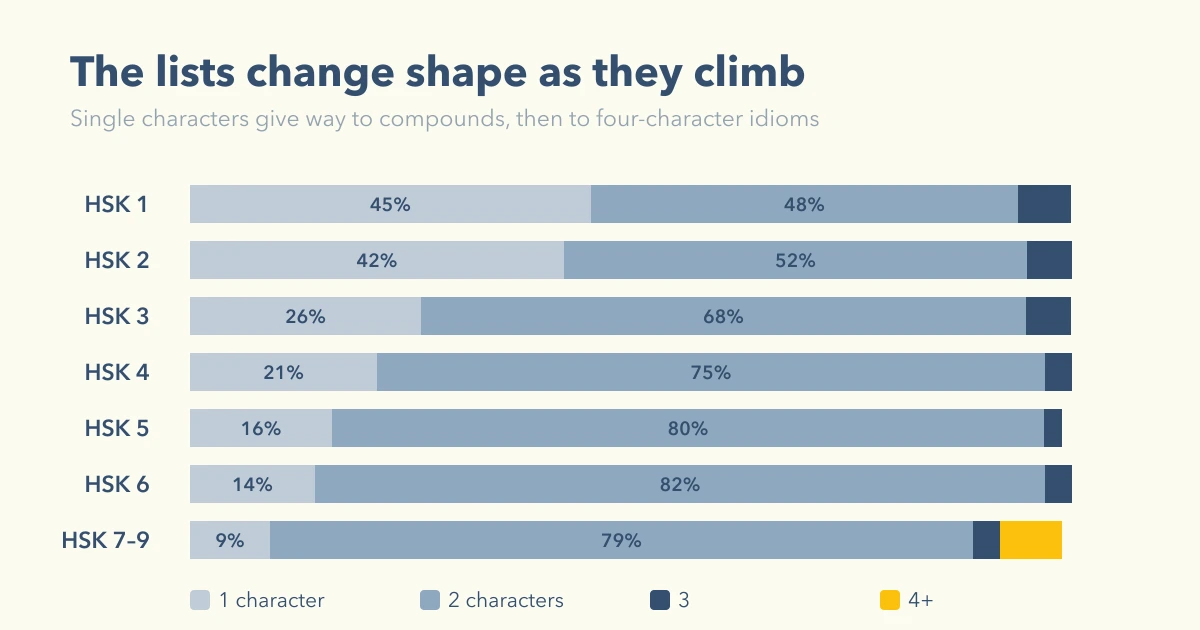
At HSK 1, 45% of the entries are single characters — 人, 好, 是, 有. You are being handed the building blocks. By HSK 4 that has dropped to 21%, and three quarters of the list is two-character compounds. At HSK 7–9 only 9% of entries are single characters, and something new appears: 430 four-character items, almost all of them set idioms, which exist nowhere in the first six lists.
So the early lists teach you characters. The later ones teach you what happens when characters are put together — and by the advanced band, a chunk of the work is memorising fixed phrases whose meaning you could not assemble from their parts. Knowing which kind of list you are holding changes how you should work through it.
What a word list is not
It is not a syllabus, and it is not an order of study.
The list is alphabetical by pinyin. Nothing about that order reflects what is useful first, what is easy first, or what belongs together. Working from 啊 to 座 is a way to spend six months and arrive able to recognise a great many words in isolation and read almost nothing.
It is also not a measure of what you know. Recognition on a list and recall in a sentence are different abilities, and the gap between them is where most self-assessment goes wrong. You will nod at 已经 on a list and fail to produce it when you need it — reading practice at each level is where that gap shows up.
What to actually do with one
Use it as an audit, not a curriculum.
Scan for gaps, don't read top to bottom. Go down the list of the level you think you've finished and mark only what you cannot produce in a sentence. On a completed level that's usually 50 to 150 words. That short list is worth more than the full one, because it's the part that isn't done.
Work in the direction of your weakness. If your gaps cluster in single characters, you have a character problem and should be drilling those. If they cluster in two-character compounds built from characters you know, you have a combination problem — a different kind of work, closer to reading than to flashcards.
Check the level below before the level above. Almost everyone has holes one band down. They are cheaper to fill and they carry more weight, because lower-level words appear far more often in anything you'll read.
Ignore the four-character entries until the rest is solid. The 430 idioms in HSK 7–9 are the highest-effort, lowest-frequency part of the entire syllabus. They belong last.
Which list you need
If you're not sure which level you're at, the list itself is a poor way to find out — you'll recognise more than you can use, and conclude you're a level higher than you are. Open the HSK 3 list instead and read down it looking for words you could put in a sentence unprompted. HSK 3 is the usual dividing line between survival phrases and reading real sentences, and it takes about two minutes to see which side of it you're on.
Every entry on all seven lists is free to open, with pinyin, stroke order and audio; most also carry an example sentence. No account, no cap.
Ready to start?
Find your HSK 3.0 level in 5 minutes — free, no card required.
Take the placement test