
Do HSK Anki decks still work for HSK 3.0?
2026-08-27 · 7 min read
Anki is still the most effective vocabulary tool most learners will ever use. The problem is not the software. It is that the overwhelming majority of shared HSK decks were built against a syllabus that no longer exists, and nothing in Anki will tell you that.
The short version
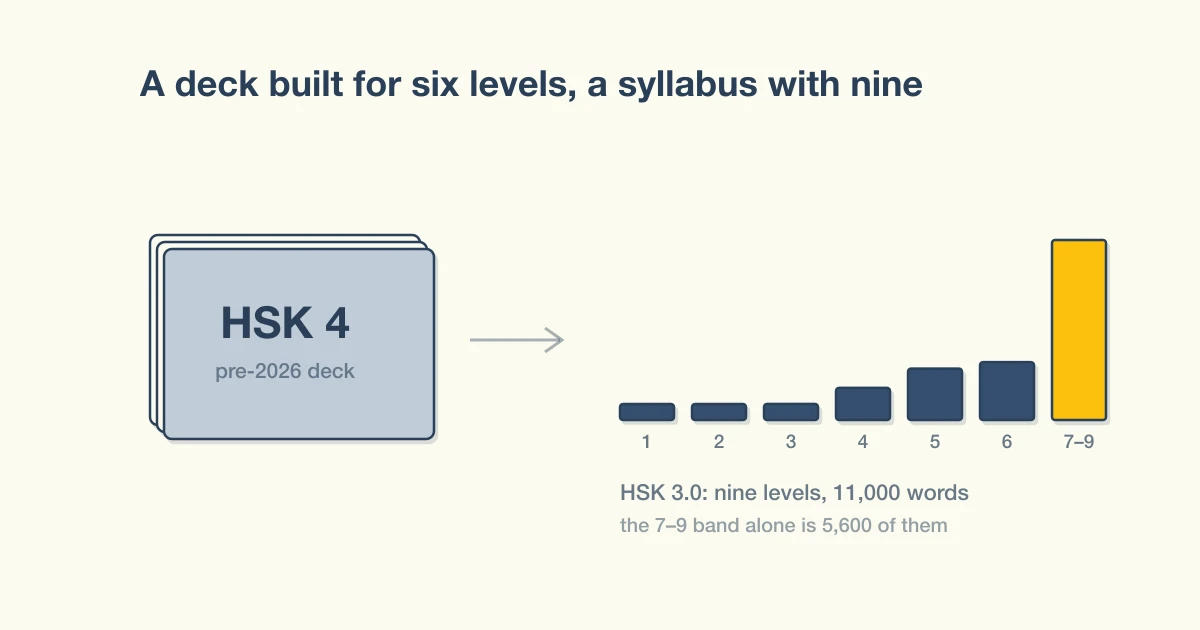
- HSK 3.0 runs to nine levels and 11,000 words. Decks built for the old six-level exam do not map onto it cleanly.
- A deck labelled "HSK 4" from before 2026 is describing a different word set from the current HSK 4.
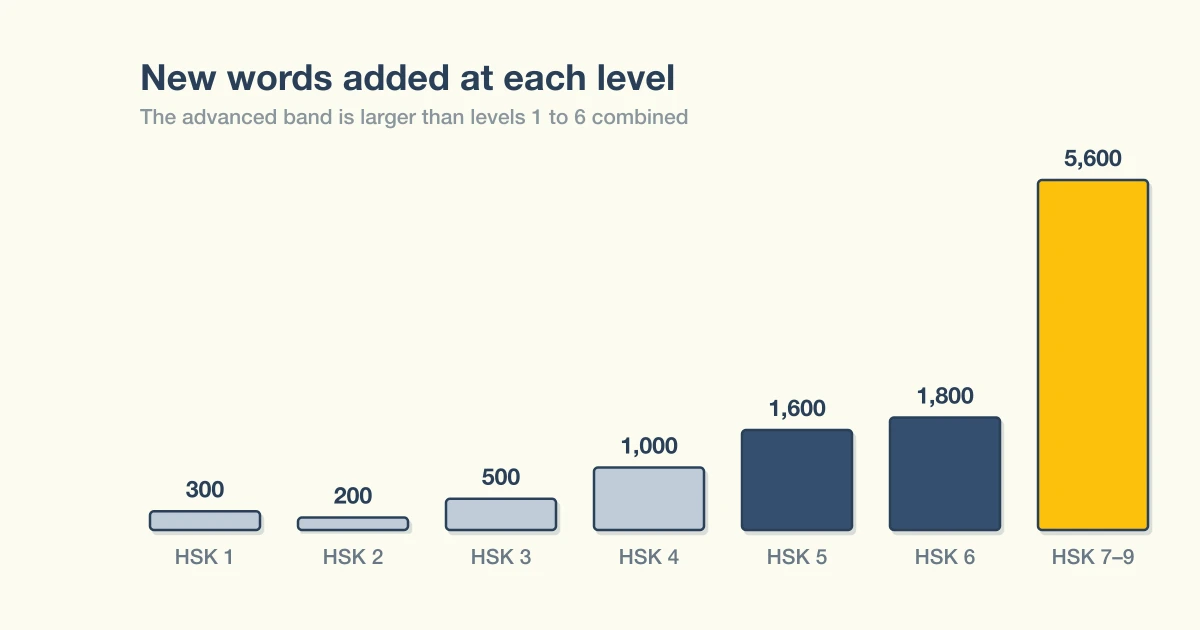
- Check any deck against the current list before committing: HSK 4 is 1,000 new words, HSK 5 is 1,600, HSK 6 is 1,800.
- Spaced repetition is still right. The card content is what needs replacing.
- Decks with audio and example sentences beat bare word-to-gloss cards, whatever the level.
What actually changed
The exam moved to a new standard in 2026. Six levels became nine, the vocabulary requirement expanded substantially, and speaking, translation and handwriting entered the assessment at defined levels. What changed in HSK 3.0 covers the reform itself.
For flashcards, one consequence matters above the rest: the level labels no longer mean what they used to. "HSK 4 vocabulary" was a defined set under the old syllabus. It is a different defined set now. A deck carrying that name from 2023 is not mislabelled out of carelessness. It was accurate when it was made.
Here is the current shape of the list:
| Level | New words | Words so far |
|---|---|---|
| HSK 1 | 300 | 300 |
| HSK 2 | 200 | 500 |
| HSK 3 | 500 | 1,000 |
| HSK 4 | 1,000 | 2,000 |
| HSK 5 | 1,600 | 3,600 |
| HSK 6 | 1,800 | 5,400 |
| HSK 7–9 | 5,600 | 11,000 |
Notice the shape. Levels 1 and 2 are small. Level 4 doubles your total in one step. The advanced band alone is bigger than levels 1 through 6 combined. Any deck that splits its cards evenly across levels is not following this syllabus.
How to check a deck in about two minutes
You do not need to audit a whole deck. Sample it.
- Count the cards per level. If the deck claims HSK 1–6 and the level sizes are not roughly 300 / 200 / 500 / 1,000 / 1,600 / 1,800, it is built on a different list.
- Check whether it has a 7–9 band at all. No 7–9 means it predates the reform. That is the fastest single tell.
- Spot-check ten words. Take ten cards from the deck's "HSK 4" and look each up in the current HSK 4 list. If two or three land in a different level, the whole deck's grading is off.
- Look at the card back. Word plus one-line gloss is the weakest possible card. Audio and an example sentence are worth more than another thousand entries.
Step 3 is the one people skip, and it is the one that gives you a real answer. Ten lookups, two minutes.
Does the mismatch actually matter?
Partly. Let us be fair about this.
It matters less than you would think for the words themselves. 学生 is still 学生. A word that was useful under the old syllabus is generally still useful. If you study an outdated deck you are not learning wrong Chinese. You are learning real vocabulary in an order that no longer matches the exam.
It matters a lot for exam planning. If you are sitting HSK 5 in four months and your deck's "HSK 5" is missing several hundred words the current syllabus expects, you will find out on exam day. The gap is invisible from inside Anki, because Anki only knows the cards you gave it.
It matters most at the top. The 7–9 band is 5,600 words, more than half the entire list. Pre-reform decks simply do not have this material, because the levels did not exist.
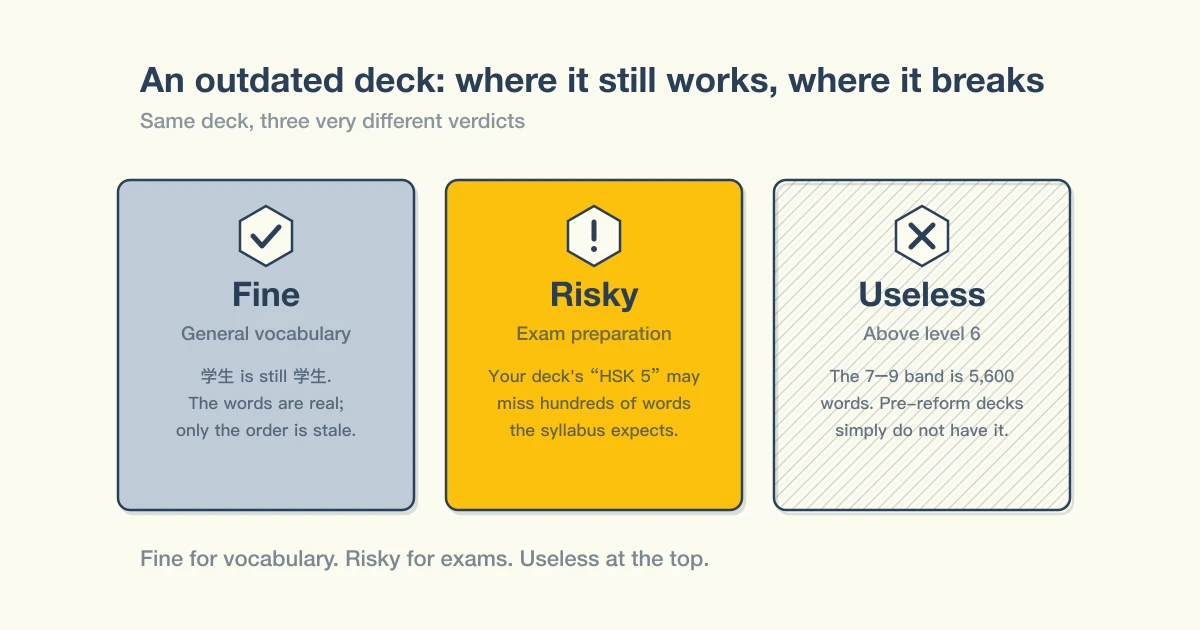
So the honest answer: fine for general vocabulary, risky for exam preparation, useless above level 6.
Building a deck that matches the current list
If you want to stay in Anki, the reliable route is to generate your own cards from the current word list rather than trusting a shared deck's labels.
Browse the level you need (HSK 3, HSK 4, HSK 5) and build from what is actually there. Each entry carries pinyin, a meaning, recorded audio and stroke order, which is everything a good card needs on the back.
Three rules worth keeping whatever tool you use:
- One card, one direction, to start: recognition first (Chinese to meaning). Add production later, when recognition is solid.
- Always include audio. A word you can read but not recognise by ear is half-learned, and listening is half the exam.
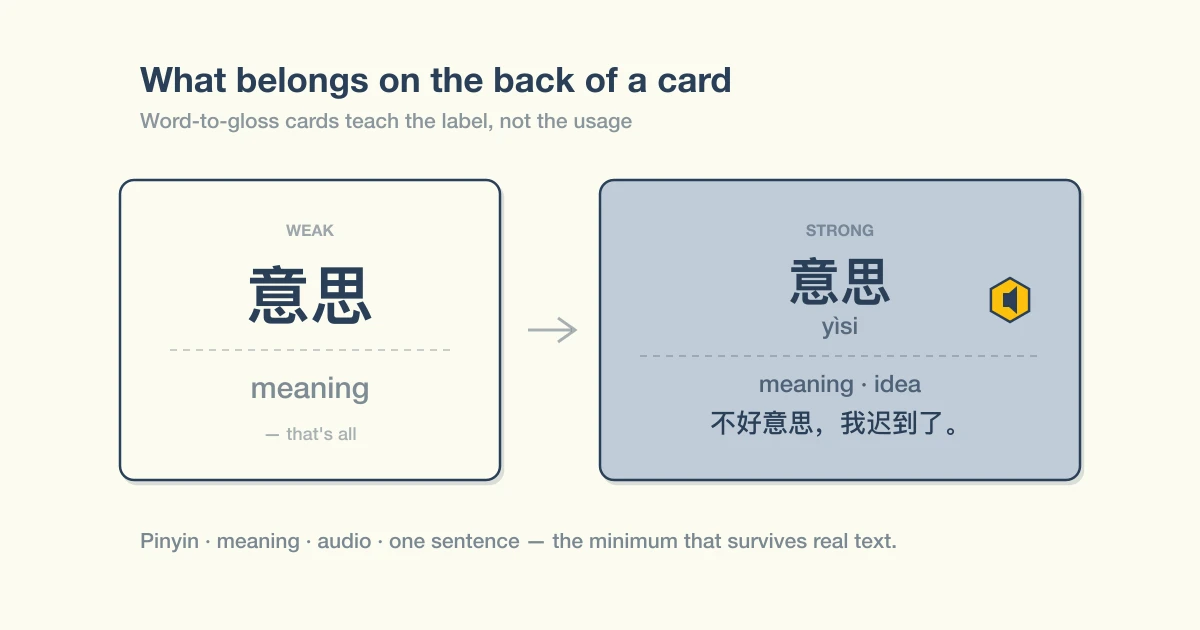
- Put the word in a sentence. Isolated glosses produce learners who know 意思 means "meaning" and still cannot parse 不好意思.
When not to bother with Anki
Spaced repetition is a tool for retention, not acquisition. It is superb at stopping you forgetting words you have already met and understood. It is poor at teaching you a word cold.
If you are below about 500 words, your time is better spent meeting vocabulary in context than tuning a review queue. And if your reviews have become a daily chore you resent, the queue is too big. Cut the daily new-card limit rather than abandoning the habit.
For most learners the practical answer is not Anki or an app, but recognition drilling somewhere with the current list built in, and Anki reserved for the stubborn words that keep slipping. How many words each level needs is a useful sanity check on how much of this you actually have to memorise.
Frequently asked questions
Are old HSK Anki decks useless now?
Not useless, but mislabelled. The vocabulary is real Chinese and still worth knowing. What has changed is which level each word belongs to, and pre-2026 decks have no 7–9 band at all, and that band is 5,600 words, over half the current list.
How many cards should an HSK 4 deck have?
Around 1,000 new words for level 4 itself, or 2,000 cumulatively if the deck includes levels 1–4. A deck claiming HSK 4 with only a few hundred cards is built on the old syllabus.
Is Anki better than a vocabulary app for HSK?
Anki gives you control and offline review; a purpose-built app gives you the current word list, audio and stroke order without any deck maintenance. Many learners use both: an app for structured coverage, Anki for words that keep slipping.
What should go on the back of a Chinese flashcard?
Pinyin, meaning, audio, and one example sentence at minimum. Word-to-gloss cards produce recognition that collapses as soon as the word appears in real text, because you learned the label rather than the usage.
One concrete step, today
Open whatever deck you are currently reviewing and count the cards in its HSK 4 section. Then open the current HSK 4 word list and pick ten words at random from your deck to look up.
If most of them sit in a different level than your deck claims, you now know something worth knowing before your next three months of reviews. And if you are not sure which level you should be drilling in the first place, the free level test takes about five minutes and tells you where you actually are on the nine-level scale.
Ready to start?
Find your HSK 3.0 level in 5 minutes — free, no card required.
Take the placement test