
Is this Chinese text at your level? Check before you read it
2026-09-05 · đọc 5 phút
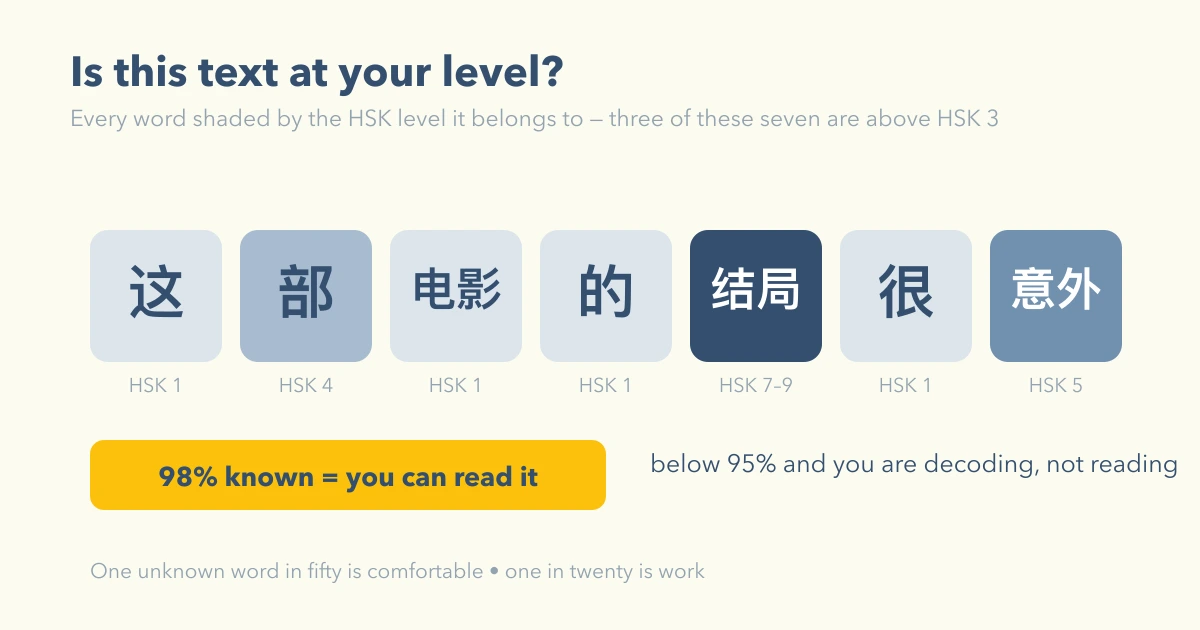
Every learner has done this: picked a Chinese article that looked interesting, got four lines in, and quietly closed it. The usual conclusion is "I'm not ready yet." Usually the real problem is narrower — the text was three levels above you, and there was no way to tell that before you started.
You can tell. It takes about fifteen seconds.
The number that decides whether reading works
Research on second-language reading keeps landing on the same threshold. To read something comfortably on your own — following the argument, guessing the odd unknown word from context, not reaching for a dictionary — you need to already know somewhere around 98% of the words on the page. Drop to 95% and comprehension starts to fail; below that, you are decoding rather than reading.
98% sounds generous until you convert it. It means one unknown word in fifty — roughly one every two or three lines. At 95% it's one in twenty, which is two or three per paragraph, and that is the point where you stop following the meaning and start assembling it.
This is why "read things slightly above your level" is bad advice when taken literally. Slightly above is fine. Two levels above is not a stretch — it's a different activity.
Why Chinese hides the problem
In English you can eyeball a page and spot the words you don't know. Chinese gives you no such warning, for two reasons.
There are no spaces. Word boundaries are not marked, so an unknown word doesn't announce itself as a shape you don't recognise. It looks exactly like the text around it.
You can know every character and still not know the word. 东西 is 东 (east) and 西 (west), and it means "thing". 马上 is "horse" and "on", and it means "immediately". Neither meaning is recoverable from the parts. Reading every character and understanding nothing is a specifically Chinese failure mode, and it makes self-assessment unreliable — the page feels familiar right up until it doesn't.
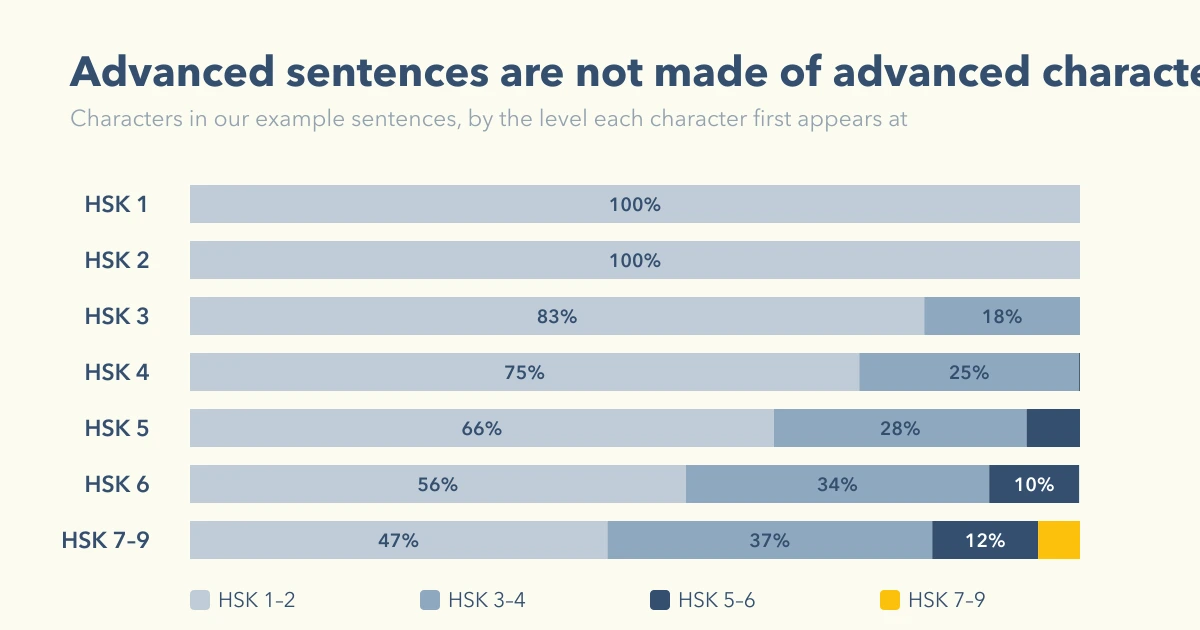
There's a measurement behind that. Across the roughly 9,000 example sentences in our own library — one per word, written to fit each level — the characters barely get harder as the levels climb. In the HSK 7–9 sentences, 47% of all characters are HSK 1–2 characters and 83% are HSK 1–4. Only about 5% belong to the advanced band at all.
So an advanced sentence is not made of advanced characters. It's made of ordinary characters in combinations you haven't met. That matches what the word lists themselves do: 45% of HSK 1 entries are single characters, against 9% at HSK 7–9, where the list turns into compounds and set phrases.
The practical consequence: skimming a text for "characters I don't recognise" will tell you it's easy. It isn't measuring the thing that makes it hard.
Checking a text in fifteen seconds
Paste a paragraph into the Chinese text analyzer. It splits the text into words and colours each one by its HSK 3.0 level, so what you get back is not a score but a picture: how much of this passage sits above where you are.
Then read the picture, not the number.
Count the words above your level, not the characters. If more than one word in twenty is above you, the passage will be work rather than reading. One in fifty and you can just read it.
Look at where they cluster. Ten unknown words spread evenly is a harder read than ten concentrated in a single technical paragraph you can skip.
Check whether the unknowns are load-bearing. An unfamiliar word in the subject or the main verb stops you. One in a list of examples does not.
What to do when a text is too hard
Don't grind through it. A passage at 90% coverage teaches very little vocabulary per hour, because too little of the context is solid enough to hang a guess on.
Two better moves. Go down a level and read more. Volume at the right level beats struggle at the wrong one, and it's how the words you half-know become words you know. Or pre-learn the gap: pull the twenty words the analyzer flagged, learn those, then read the piece. Fifteen minutes of preparation turns an impossible text into a comfortable one — and it works because you fixed the coverage, not because you tried harder.
Keep the article you closed. Run it through the analyzer in a month. Watching the colours go pale is a more honest progress report than any level number.
Sẵn sàng bắt đầu chưa?
Tìm ra cấp HSK 3.0 của bạn trong 5 phút — miễn phí, không cần thẻ.
Làm bài kiểm tra xếp cấp