
How do you count Chinese characters and words?
2026-08-27 · đọc 7 phút
Every Chinese text has two lengths, and they are never the same number. Count the characters, you get one figure. Count the words, you get a smaller one. That gap trips people up constantly: in essay limits, in study targets, in "I know 2,000 words" claims that turn out to mean something else entirely.
The short version
- Characters (字) are the individual blocks. Words (词) are units of meaning, and most take two characters.
- Only 14.5% of HSK 3.0 vocabulary entries are single characters. The other 85.5% run to two or more.
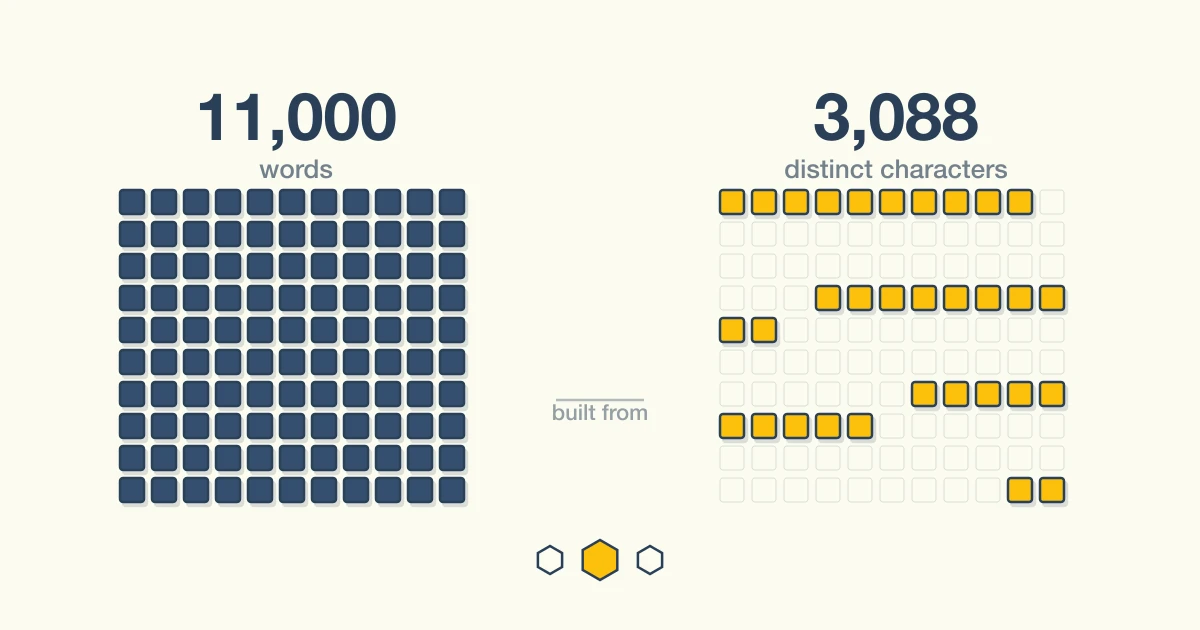
- The full 11,000-word list is built from just 3,088 distinct characters.
- Word length climbs with level: 1.61 characters per word at HSK 1, 2.10 across the 7–9 band.
- Essay limits and word counts in Chinese almost always mean characters.
Why one text has two lengths
A character is one block in the writing system: 好, 中, 学. A word is a unit of meaning, and in modern Chinese it usually takes two of those blocks: 学生 (student), 中国 (China), 好看 (good-looking).
So 我是学生 is four characters and three words (我 / 是 / 学生). Neither count is wrong. They measure different things.
English hides this problem because spaces do the work for you. Chinese has no spaces, so software has to guess where the word boundaries fall, and different software guesses differently. That's why two tools can hand you two different word counts for the same paragraph, while agreeing exactly on the character count.
Characters are countable without judgement. Words require a decision. Keep that distinction and most of the confusion goes away.
How far apart are the two numbers?
Far enough to matter. We counted every entry in the HSK 3.0 vocabulary list and tracked how many distinct characters it takes to write them:
| Level | New words | Words so far | New characters | Characters so far | Avg. characters per word |
|---|---|---|---|---|---|
| HSK 1 | 300 | 300 | +248 | 248 | 1.61 |
| HSK 2 | 200 | 500 | +123 | 371 | 1.64 |
| HSK 3 | 500 | 1,000 | +284 | 655 | 1.78 |
| HSK 4 | 1,000 | 2,000 | +441 | 1,096 | 1.83 |
| HSK 5 | 1,600 | 3,600 | +431 | 1,527 | 1.87 |
| HSK 6 | 1,800 | 5,400 | +413 | 1,940 | 1.91 |
| HSK 7–9 | 5,600 | 11,000 | +1,148 | 3,088 | 2.10 |
Look at the two "so far" columns side by side. The vocabulary grows 37 times over from HSK 1 to the full list. The character set grows about 12 times. Words multiply much faster than the blocks used to build them.
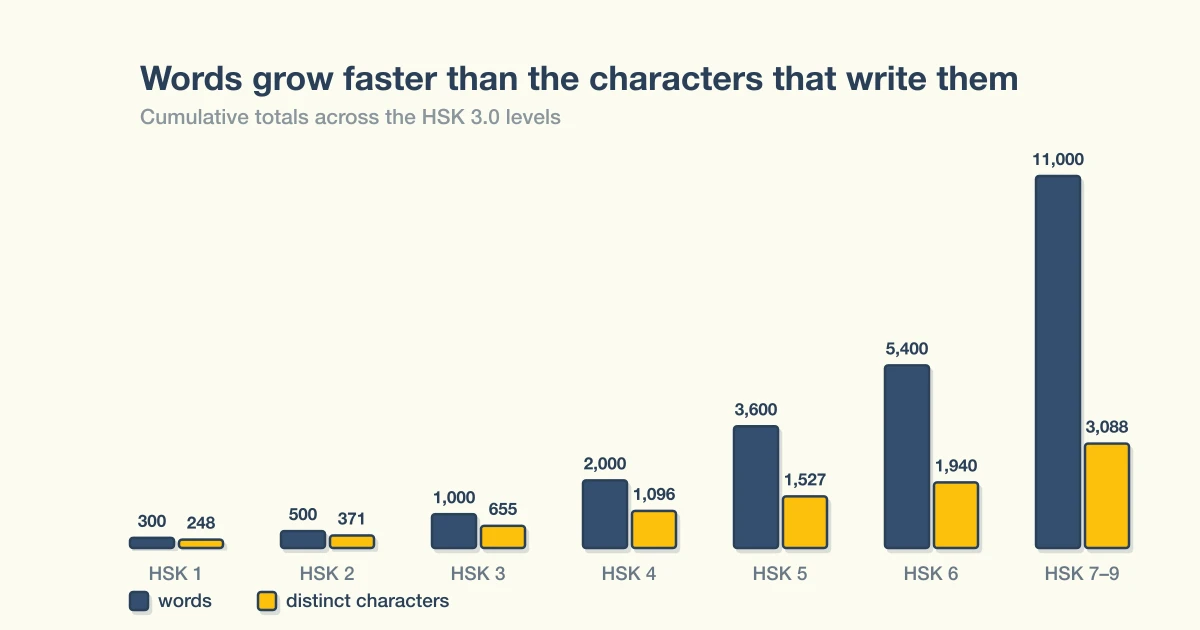
There is a second pattern in that last column, and it is the one learners feel. Average word length climbs steadily: 1.61 characters at HSK 1, 2.10 by the advanced band. Advanced Chinese is not just more words. It is longer words, built by combining characters you already met at lower levels.
That's also the good news. By HSK 6 you have seen 1,940 characters, and the entire 7–9 band adds only 1,148 more. Most of what makes advanced text hard is recombination, not fresh symbols. How many characters you actually need goes into where the useful ceiling sits.
Which count does your task want?
Nearly always characters. A few common cases:
- Essay and assignment limits: when a Chinese task says 300字, it means 300 characters. A "300-word" essay in the English sense would be roughly double the length. Getting this backwards is the single most common way people overshoot a limit.
- Exam writing tasks: length guidance in Chinese exams is given in characters, and graders count them the same way.
- "I know N words" claims: almost always words, meaning vocabulary entries of the kind you would find on a list. Someone who says they know 3,000 words is describing roughly HSK 5 coverage, not 3,000 characters.
- Reading-speed measurements: usually characters per minute, because it is the count that does not depend on which segmenter you use.
When you're unsure, ask which number the other person can verify without software. That's the character count.
Counting them without doing it by hand
For anything longer than a sentence, use a tool. Paste your text into the Chinese character counter and it reports both numbers side by side, plus how many characters are distinct rather than repeated.
That last figure is more useful than it sounds. A 500-character essay that uses only 180 distinct characters is repeating itself. Watching the ratio is a quick, honest check on whether your writing is actually varied. No marker required.
If you want to know which of those characters are above your level, the text analyser tags every word in a passage with its HSK band. Paste in something you are struggling to read and you can see immediately whether the problem is vocabulary or grammar.
What this means when you sit down to write
Two habits are worth building early.
Write to the character limit, not to a feeling. Most people badly misjudge length in a second script. Draft, count, then adjust. After a dozen rounds you'll develop a reliable instinct for what 200 characters looks like in your own handwriting.
Track distinct characters, not just total length. Hitting a limit is easy if you lean on the same handful of constructions. Widening the distinct count is what actually moves a writing score, and it is measurable from the first draft.
Both of these work at any level, and neither needs a teacher to check.
Frequently asked questions
Is a Chinese character the same as a word?
No. A character is one block in the writing system; a word is a unit of meaning. Only 14.5% of HSK 3.0 vocabulary entries are single characters. The other 85.5% combine two or more, like 学生 (student) from 学 and 生.
Why do two tools give different Chinese word counts?
Chinese has no spaces, so software must guess where words begin and end. Different segmentation algorithms split the same sentence differently. Character counts do not have this problem, which is why they are the more reliable figure to quote.
Does 300字 mean 300 words or 300 characters?
Characters. A Chinese task asking for 300字 wants roughly 300 characters, which is far shorter than a 300-word English essay. Treating it as words is the most common way learners overshoot the limit.
How many characters do I need for the HSK 3.0 word list?
3,088 distinct characters cover the entire 11,000-word list. You reach 1,096 by HSK 4 and 1,940 by HSK 6. The advanced 7–9 band adds only 1,148 more, because most advanced vocabulary recombines characters you already know.
One concrete step, today
Take something you wrote in Chinese recently (a homework paragraph, a message, anything) and run it through the character counter. Note two numbers: total characters, and distinct characters.
The ratio between them tells you more about your writing than the length does. If you're reusing the same 150 characters across a 400-character piece, your next study session has an obvious target. And if you would rather find out where your vocabulary sits before writing anything, the free level test takes about five minutes and reports which band you are actually reading at.
Sẵn sàng bắt đầu chưa?
Tìm ra cấp HSK 3.0 của bạn trong 5 phút — miễn phí, không cần thẻ.
Làm bài kiểm tra xếp cấp