
Chinese tones are not equally common — and the rarest gets the most drilling
2026-09-08 · 6분 읽기
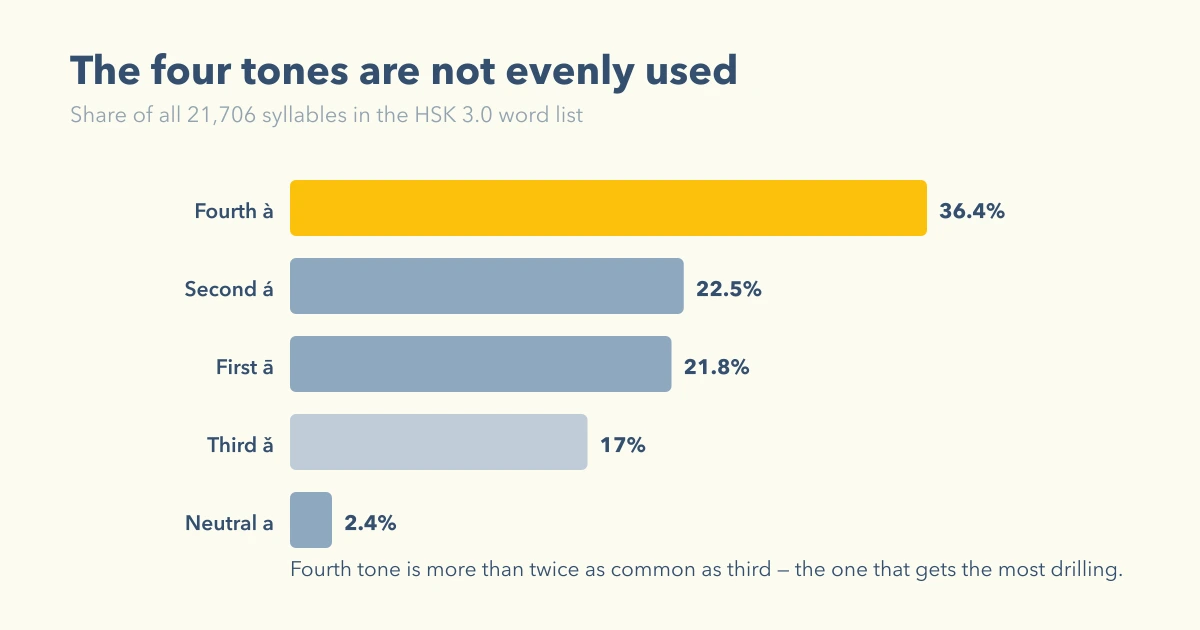
Every beginner is taught the four tones as though they were evenly distributed — four boxes, 25% each, learn them in order. They are not evenly distributed, and knowing the real shape changes what you should practise.
Here is what 11,000 HSK 3.0 words, or 21,706 syllables, actually contain.
The tones are not evenly used
| Tone | Share of syllables |
|---|---|
| Fourth (à) — falling | 36.4% |
| Second (á) — rising | 22.5% |
| First (ā) — high flat | 21.8% |
| Third (ǎ) — dipping | 17.0% |
| Neutral (a) | 2.4% |
Fourth tone is more than twice as common as third. Better than one syllable in three falls, and the sharp downward contour that beginners find theatrical is the single most ordinary sound in the language.
Third tone — the one that gets the most drilling, the most diagrams, the most anxious repetition — is the rarest of the four.
That inversion is worth sitting with. The tone you spend the most time on is the one you meet least, and the tone you meet most tends to get waved through as "the easy angry one".
What that means for practice
Fourth tone deserves the drilling. Not because it is hard to produce in isolation — it is the easiest — but because it appears so often that a slightly weak fourth tone degrades more of your speech than a perfect third tone repairs. If your fourth tone is not decisively falling, over a third of your syllables are ambiguous.
Third tone is over-taught relative to its frequency. It is also, in running speech, usually not the full dipping contour taught in isolation — before another syllable it is normally just a low tone that never rises back. Learners who practise the textbook dip in every position sound careful and slightly wrong.
Neutral tone is under-taught relative to its importance. Only 2.4% of syllables, but they cluster in the highest-frequency words in the language: 的, 了, 吗, 呢, and the second syllable of 爸爸, 妈妈, 朋友, 学生, 东西. Getting neutral tone wrong marks your speech as non-native faster than a missed third tone, because the words it lives in are the ones you say every sentence.
Tones come in pairs, and the pairs are lopsided too
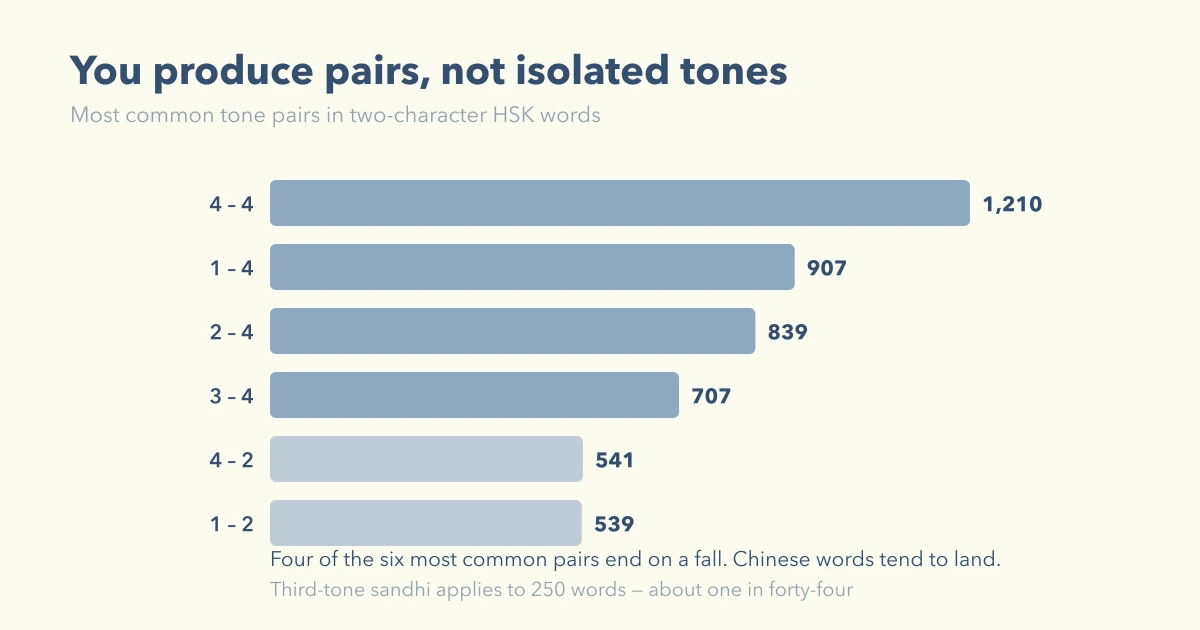
Most Chinese words are two syllables, so what you actually produce is tone pairs. Counting every two-character word in the syllabus:
| Pair | Words |
|---|---|
| 4-4 | 1,210 |
| 1-4 | 907 |
| 2-4 | 839 |
| 3-4 | 707 |
| 4-2 | 541 |
| 1-2 | 539 |
Four of the six most common pairs end in fourth tone. Chinese words tend to land, and drilling pairs that end on a fall is drilling the shape of the language rather than a table of abstract combinations.
The sandhi rule, in proportion
Every course teaches that two third tones in a row change: the first becomes second tone, so 你好 is said nǐ hǎo but pronounced ní hǎo.
The rule is real and you do need it. But it applies to 250 two-character words in the entire 11,000-word syllabus — about one word in forty-four.
It gets taught in week one, right next to the tones themselves, and often occupies a whole lesson. Weigh that against fourth tone, which is 36% of everything you will ever say and gets a paragraph.
The 不 and 一 tone changes deserve the same treatment: real, learnable in ten minutes, and not worth the anxiety they generate. Learn the rule, apply it to the handful of words where it fires, and go back to making your fourth tone fall properly.
What tone marks do and do not tell you
Tone marks are a citation convention. They record the tone a syllable has in the dictionary, not the one it takes in a sentence — sandhi, neutralisation and sentence stress all move the actual pitch. Any tool that shows you tone marks, ours included, is showing you what to memorise, not what a native speaker says.
That is the right thing to memorise. Just do not be surprised when the recording and the marks disagree.
What a tone error actually costs
Worth being precise, because the fear around tones is out of proportion to the consequence in most situations.
Context absorbs most single errors. If you ask for 水饺 (dumplings) and produce 睡觉 (sleep) in a restaurant, nobody hands you a pillow. The classic minimal-pair jokes are real pairs and almost never real misunderstandings, because sentences carry far more information than one syllable.
Systematic errors cost much more than random ones. A learner who gets tones right 80% of the time at random is understood. A learner who always flattens second tone into first is hard to follow, because the listener cannot calibrate — every rising tone in the language is now missing.
The expensive failure is in the words you say constantly. Getting the neutral tone wrong on 的, 了, 吗 or on the second syllable of 爸爸 and 学生 marks every sentence you speak. Getting a fourth tone wrong on a word you use twice a year marks nothing.
That ordering — systematic before random, frequent before rare — is what should drive practice, and it is close to the opposite of what a tone-pair drill sheet gives you.
Where to put the hours
- Fourth tone, until falling is automatic. A third of your syllables.
- Neutral tone, on the specific words that have it. Small category, enormous frequency.
- Tone pairs, not isolated tones. You produce pairs; drill pairs.
- Third-tone sandhi, once, as a rule. Then stop worrying about it.
- First versus second tone, if you have an accent that flattens rises. Together they are 44% of syllables and they are the pair most often confused by speakers of non-tonal languages.
How to practise them, concretely
Record yourself and compare, don't just listen. Perception improves faster than production, which means you will hear that a native recording differs from yours long before you can say why. Recording forces the comparison; listening alone lets you assume you matched.
Drill in pairs, from the frequency list above. 4-4, 1-4, 2-4, 3-4 cover the four most common shapes in two-syllable words. Twenty minutes on those buys more than an hour on isolated syllables.
Say the whole word, never the syllable. Tones in Chinese are realised across the word, not stamped on each syllable independently, and a syllable practised alone acquires a boundary pause that has to be unlearned.
Check your hardest pair specifically. For most speakers of non-tonal languages it is 2 versus 3 — both involve a low region and the difference is whether the pitch comes back up. Together they are 39.5% of syllables, so a systematic confusion there affects two syllables in five.
The four tones are equal in a textbook table and nowhere else.