
What is HSK 3.0? The new Chinese exam, explained
2026-07-13 · 7분 읽기
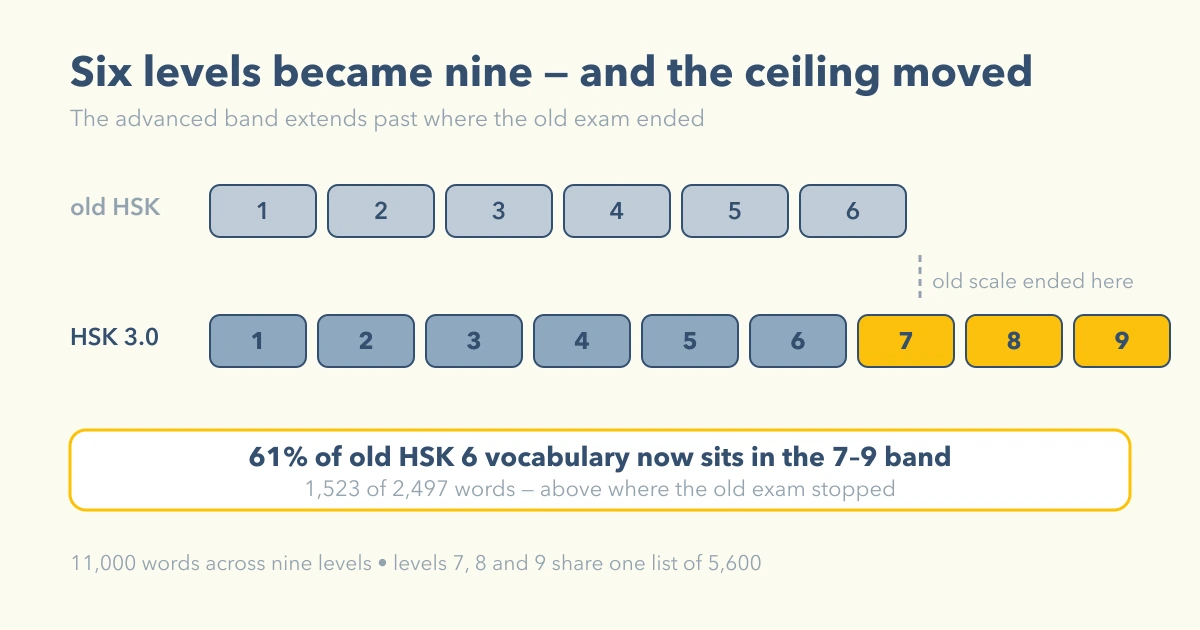
The HSK — the standard proficiency exam for Chinese as a foreign language — moved to a new standard in 2026, generally called HSK 3.0. It is the largest change to the exam in more than a decade, and most study material written for the old test is now describing an exam that no longer exists in that form.
Here is what changed, with the numbers.
Six levels became nine
The old exam ran HSK 1–6. The new standard defines nine levels in three bands: elementary (1–3), intermediate (4–6) and advanced (7–9).
The nine is not a finer slicing of the same range. The advanced band extends well past where the old scale stopped — of the old HSK 6 vocabulary, 61% now sits in the 7–9 band. The exam did not just add resolution; it added ceiling. Where your old level lands goes through the mapping word by word.
The vocabulary roughly doubled
| Level | New words | Running total |
|---|---|---|
| HSK 1 | 300 | 300 |
| HSK 2 | 200 | 500 |
| HSK 3 | 500 | 1,000 |
| HSK 4 | 1,000 | 2,000 |
| HSK 5 | 1,600 | 3,600 |
| HSK 6 | 1,800 | 5,400 |
| HSK 7–9 | 5,600 | 11,000 |
Two features of this table catch people out.
HSK 2 is smaller than HSK 1 — the only step in the sequence that asks for less than the one before it.
Levels 7, 8 and 9 share one list of 5,600 words, larger on its own than levels 1 through 6 combined. There is no separate "HSK 8 word list" to find, because the standard defines the band rather than three vocabularies inside it.
At matching level numbers the requirement is close to 1.7× the old syllabus: old HSK 4 asked for roughly 1,200 cumulative words, new HSK 4 asks for 2,000.
The lists change character as they climb
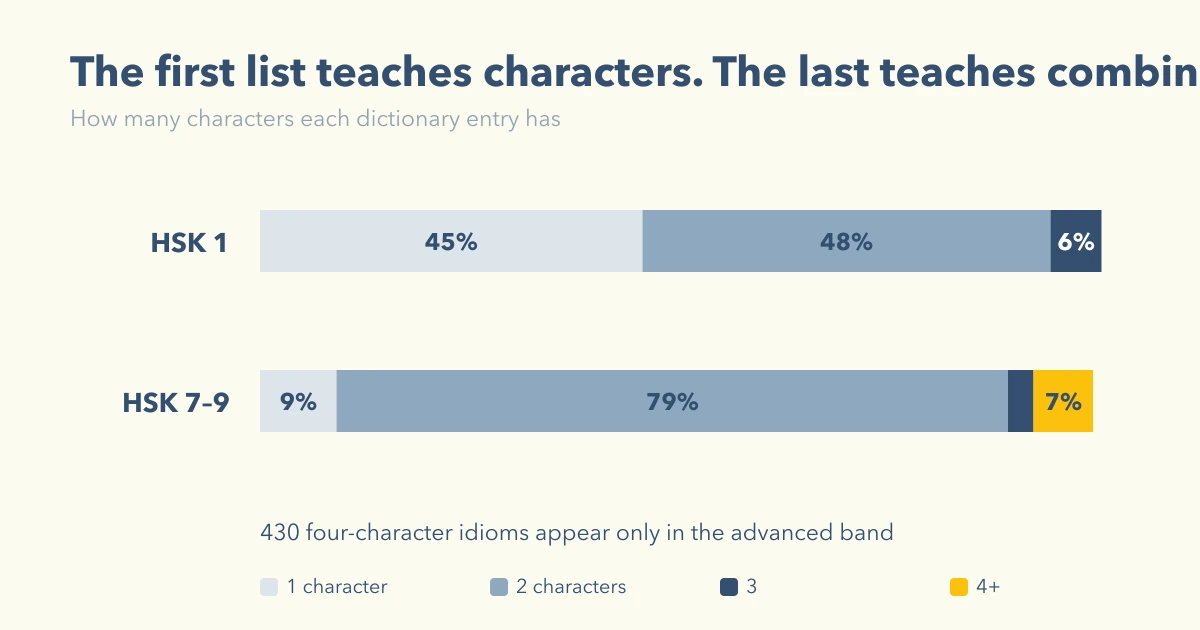
Counting how many characters each entry has shows the syllabus doing something different at each end.
At HSK 1, 45% of entries are single characters — 人, 好, 是. You are being handed building blocks. By HSK 4 that is down to 21%. At HSK 7–9 only 9% are single characters, and 430 four-character idioms appear, a category absent from the first six lists entirely.
So the early levels teach you characters and the later ones teach you what happens when characters combine. That is worth knowing before you plan how to study: flashcard drilling suits the first kind of list far better than the second.
New skills, at defined levels
The old written exam mostly measured reading and listening. The new standard brings in three more, each entering at a specific level rather than at the top:
- Speaking from level 3 — earlier than most learners expect, and the one most commonly neglected. The separate HSKK speaking exam is a related but distinct test.
- Translation from level 4.
- Handwriting from level 5 — see practising Chinese handwriting for what that involves.
A learner who reads well and has never spoken aloud is now, formally, incomplete from the elementary band upward.
What this means for you
If you are starting now, you are not behind. Everyone is working from a syllabus that is barely a year old, and material built natively for 3.0 is scarce. Studying from a 3.0-native word list beats studying from a converted 2.0 one.
If you have an old certificate, do not assume it converts by adding levels. The mapping is uneven — the bottom of the scale got slightly easier, the top got considerably harder.
If you are using older material, check what it was built for. An HSK 5 question bank written before 2026 is testing a vocabulary list that has been redrawn, in formats the current exam may not use.
Where to start today
Reading about a reform doesn't tell you where it leaves you. Two concrete steps, in order.
Sit the free adaptive level test: about five minutes, scored on the nine-level scale, and it names the skill dragging your result down rather than just returning a number.
Then open the HSK 3 vocabulary list. HSK 3 is the usual dividing line between survival phrases and reading real sentences — 1,000 cumulative words, free to browse with pinyin, stroke order and audio on every entry. If most of it is familiar, try a free mock test in the new formats. Fifteen minutes there will tell you more than another article about the reform.