
How to learn Mandarin fast: order beats method
2026-09-08 · 6 menit baca
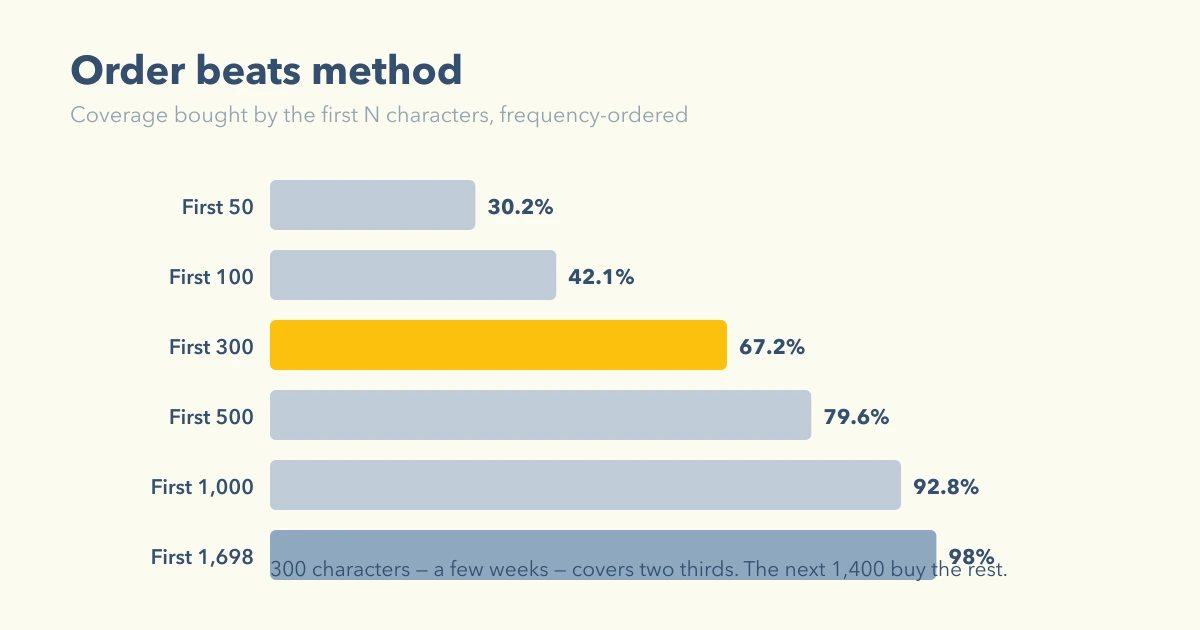
"Learn Mandarin fast" usually gets answered with method — this app, that technique, immersion, spaced repetition. Method matters less than most people selling it claim. What actually determines speed is order, and the order question has a numeric answer.
Fast means front-loading, and the curve is extreme
Rank every character in a corpus of 9,005 HSK example sentences by how often it appears, then add up coverage:
| Characters | Coverage of text |
|---|---|
| 50 | 30.2% |
| 100 | 42.1% |
| 300 | 67.2% |
| 500 | 79.6% |
| 1,000 | 92.8% |
| 1,698 | 98.0% |
Three hundred characters — a few weeks of serious work — covers two thirds of everything written. The next 1,400 characters buy the remaining 31%.
No study method changes that shape. It is a property of the language, and it means the single biggest lever on your speed is making sure the first few hundred items you learn are the highest-frequency ones. Everything else is optimisation at the margin.
The three real accelerators
Order. Covered above. Frequency-ordered study beats syllabus-ordered study by about thirteen percentage points of coverage in the first few hundred characters, and the gap closes by around HSK 5. If your goal is to read soon, this is the largest available win.
Recognition before production. You can recognise far faster than you can produce, and recognition is what unlocks input. Learners who insist on being able to write and say everything before moving on progress at roughly half the rate of those who let recognition run ahead — because input volume is what drives everything else.
Volume of comprehensible input. Once you have a few hundred characters, hours spent reading and listening at the right level beat hours spent on flashcards. The right level is specific: about 98% known words, which is one unknown word in fifty. Above that ratio you are decoding, and decoding is slow for everyone.
The three things that feel fast and are not
Learning characters in isolation past the first 500. Beyond that point coverage grows faster through words than through characters, because you start meeting characters you already know in new combinations. Isolated-character study keeps feeling productive long after it has stopped being efficient.
Studying material above your level because it is interesting. A text at 90% coverage teaches very little per hour — too little context is solid enough to support a guess. The frustration is real and the learning is not.
Grinding tones in isolation. Fourth tone is 36% of all syllables and third-tone sandhi applies to 250 words in the entire syllabus, yet the second usually gets more class time than the first.
What the syllabus actually asks, in hours
The vocabulary requirement, cumulative:
| Level | Words | Distinct characters |
|---|---|---|
| HSK 1 | 300 | 248 |
| HSK 2 | 500 | 371 |
| HSK 3 | 1,000 | 655 |
| HSK 4 | 2,000 | 1,096 |
| HSK 5 | 3,600 | 1,527 |
| HSK 6 | 5,400 | 1,940 |
| HSK 7–9 | 11,000 | 3,088 |
At a sustainable ten new words a day — which is a real pace, not an aspirational one — HSK 3 is about a hundred days of vocabulary work. HSK 4 is another hundred. HSK 6 is roughly a year and a half from zero on vocabulary alone, and vocabulary is the part that scales linearly; listening and writing do not.
Anyone promising HSK 4 in three months is promising thirty new words a day, retained. That number is not impossible for a full-time student with no job. It is not what most people asking the question have.
What a realistic week looks like
Ten new words a day is the number that keeps coming back, so it is worth showing what it costs and what it does not.
Ten new items plus review of everything due is roughly 25–40 minutes on a spaced system, once your backlog reaches steady state. That is the whole vocabulary budget. It is not the whole study budget — reading, listening and speaking sit on top — but it is the part that is predictable and the part people over-estimate.
Seventy words a week is HSK 3 (1,000 cumulative) in about fifteen weeks from zero. HSK 4 in about thirty. Those are believable numbers for someone with a job, and they are two to three times slower than the marketing figures attached to most courses.
The variable that actually breaks the schedule is not daily volume. It is missed days: a spaced system with a week's gap returns a backlog that takes several days to clear, and two of those in a month costs more than lowering your daily target ever would.
The plateau, and why it is not a plateau
Somewhere around HSK 4 almost everyone reports that progress has stopped. It has not; the measurement has changed.
Up to that point every hour buys visible coverage — the frequency curve is steep, and you can feel new text opening up week by week. Past a thousand characters the same hour buys a fraction of a percentage point of coverage, so the feeling of progress collapses even though the learning rate is unchanged.
The fix is to change what you measure. Coverage stops being a useful yardstick at that level; what improves instead is speed, comfort and the range of registers you can handle. Reading something in ten minutes that took twenty-five last month is real progress that a word count will never show you.
The honest fast track
If "fast" means the shortest path to reading real material:
- First 300 characters, frequency-ordered, three to four weeks. Nothing else competes for attention.
- Then words, not characters. By 500 characters the returns have moved.
- Start reading at 98% coverage as soon as you can find material there. Graded, boring, comfortable material beats interesting material you cannot follow.
- Let recognition lead production by several months. Deliberately.
- Check coverage rather than counting items. Paste what you want to read into a text analyzer and look at the fraction above your level. That number predicts whether the next hour will teach you anything; a word count does not.
The realistic ceiling on speed is set by how many items you can retain per day and by the frequency curve. Method changes the margin. Order changes the outcome.
Siap memulai?
Temukan level HSK 3.0 Anda dalam 5 menit — gratis, tanpa kartu kredit.
Ikuti tes penempatan