
HSK reading practice: what each level actually asks you to read
2026-08-27 · 8 menit baca
Most people practise HSK reading by grinding question sets until the score stops moving. That works, slowly. It also hides the more useful question: what is actually different about reading at level 5 versus level 3, and which of those differences is currently costing you marks?
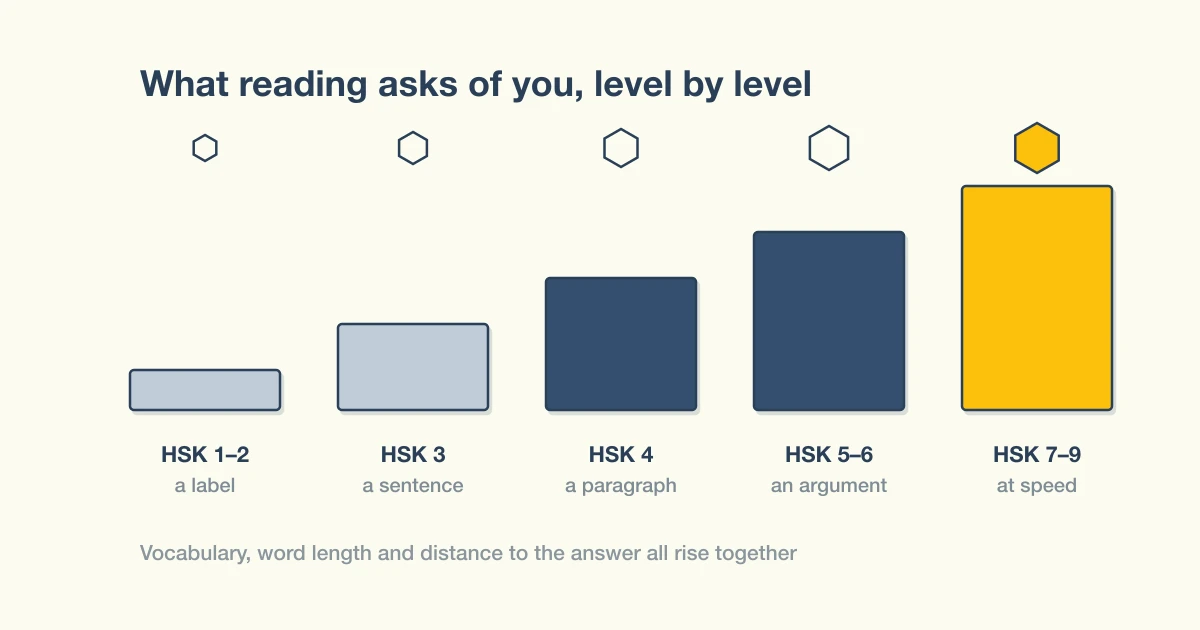
The short version
- Reading difficulty rises on three axes at once: vocabulary size, word length, and how much text sits between the question and the answer.
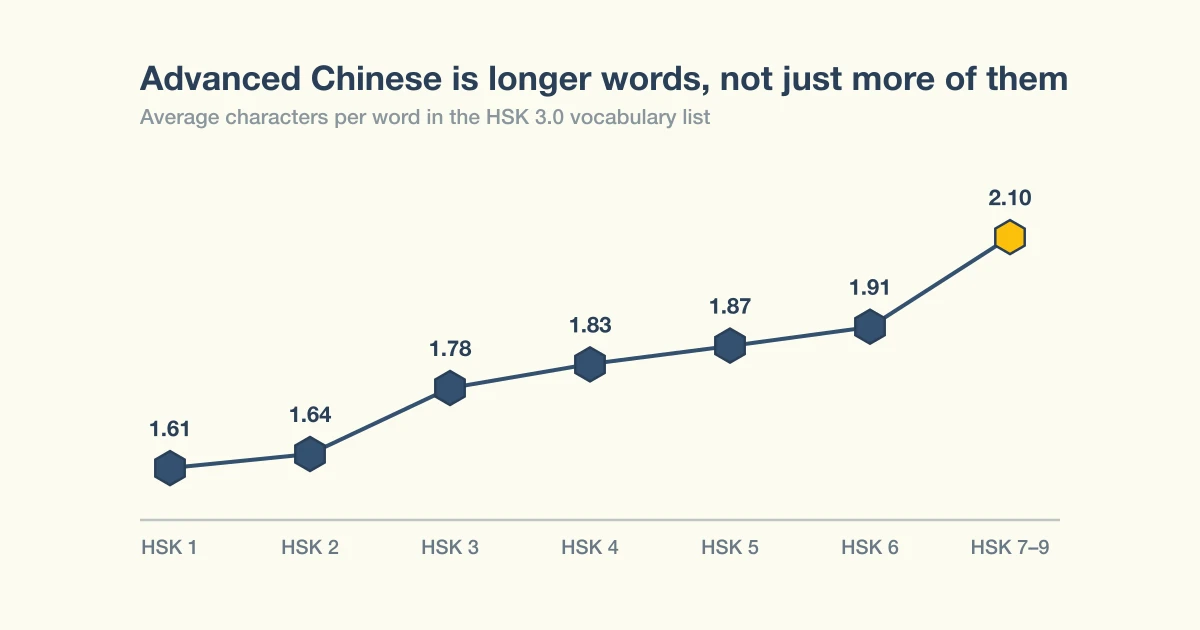
- Average word length climbs from 1.61 characters at HSK 1 to 2.10 across the 7–9 band. Advanced text is longer words, not just more of them.
- The HSK 3 to HSK 4 jump doubles your vocabulary (1,000 to 2,000 words), the biggest single step in the ladder.
- By HSK 6 you have met 1,940 distinct characters; the whole 7–9 band adds only 1,148 more.
- If you can decode every word but still miss the answer, the problem is not vocabulary.
The three things that get harder
Reading tasks scale on more than word count, and they do not scale evenly.
More vocabulary: obvious, and the one everyone trains. The list grows from 300 words at HSK 1 to 11,000 across all nine levels.
Longer words: less obvious. As you advance, meaning shifts into two-, three- and four-character compounds. You stop reading 好 and start reading 好奇心. The characters are familiar; the unit is not.
More distance: at the lower levels, the answer sits in the sentence you just read. Higher up, you have to hold a claim in your head across a paragraph, then match it against an option that deliberately paraphrases it. That is a working-memory task, not a vocabulary task, and it is the one that catches people who "know all the words".
Here is what the first two look like in the actual word list:
| Level | Words so far | Distinct characters so far | Avg. characters per word |
|---|---|---|---|
| HSK 1 | 300 | 248 | 1.61 |
| HSK 2 | 500 | 371 | 1.64 |
| HSK 3 | 1,000 | 655 | 1.78 |
| HSK 4 | 2,000 | 1,096 | 1.83 |
| HSK 5 | 3,600 | 1,527 | 1.87 |
| HSK 6 | 5,400 | 1,940 | 1.91 |
| HSK 7–9 | 11,000 | 3,088 | 2.10 |
HSK 1–2 reading: matching, not really reading
At the first two levels you are working with 300 to 500 words, and text comes in fragments: a label, a short sentence, a picture to pair it with. Pinyin support is there at the very bottom.
The skill being tested is recognition speed. Can you see 医院 and know it means hospital without stopping to decode both characters?
What to practise: recognition drills, not passages. You want the gap between seeing a word and knowing it to shrink toward zero. Browsing the HSK 1 word list with the audio on does more at this stage than any reading exercise.
HSK 3 reading: the first real sentences
HSK 3 is where reading starts to feel like reading. You have 1,000 words and 655 characters, pinyin is gone, and questions run on complete sentences rather than labels.
The usual failure here is not vocabulary. It is function words: 就, 才, 却, 还是, the small pieces that decide whether a sentence means "only then" or "only if". Learners skim past them chasing the content words, then pick a wrong answer that contains all the right nouns.
What to practise: read sentences slowly and out loud, and make yourself account for every small word. If you cannot say what 就 is doing in a sentence, you have not read it yet. The HSK 3 word list is 500 new words on top of level 2, and a surprising share of the hard ones are two characters long and abstract.
HSK 4 reading: the vocabulary cliff
This is the biggest single jump in the whole system. HSK 3 asks for 1,000 words; HSK 4 asks for 2,000. You double your vocabulary in one level, and passages grow from single sentences to short paragraphs.
Two things change at once, which is why level 4 feels disproportionately hard. You are decoding more unknown words and tracking meaning across more sentences than before.
What to practise: timed paragraph reading. Set a clock, read a short paragraph once, then answer without looking back. If you cannot, you were decoding rather than reading. The fix is more familiar vocabulary, not more careful reading. See how many words each level needs for what the ladder actually asks.
HSK 5–6 reading: following an argument
By level 6 you have 5,400 words and 1,940 characters, and the passages have opinions. Text makes a claim, qualifies it, maybe concedes a point, then concludes. Questions ask what the author thinks, not what the passage says.
Wrong options at this level are built to be tempting. They typically use the passage's own vocabulary while inverting the relationship between ideas. If you match on keywords, you will pick them.
What to practise: after each passage, say the author's position in one sentence, in your own words, before looking at the options. If you cannot summarise it, no amount of re-reading the options will help. The text analyser is useful here. Paste a passage you found hard and it tags every word with its level, so you can tell whether you were beaten by vocabulary or by structure.
HSK 7–9 reading: volume and speed
The advanced band adds 5,600 words, but only 1,148 new characters. Read that again. The character set barely moves. What changes is density, register and pace: longer texts, specialist vocabulary, and less time per line.
What to practise: reading a lot, at length, on unfamiliar topics. At this stage the constraint is stamina rather than decoding. If you finish advanced passages with the clock beating you rather than the words, you need volume, not review.
How to tell which axis is actually failing you
Next time you get a reading question wrong, sort it into one of three buckets:
- I did not know a key word. → Vocabulary. Train the list for your level.
- I knew every word but picked the wrong option. → Structure. Practise summarising before you look at the answers.
- I ran out of time. → Speed. Read more, and read easier material than you think you need.
Most learners assume bucket 1 and train for it exclusively. In practice, from level 4 up, bucket 2 is where the marks quietly go.
Frequently asked questions
What level is HSK reading actually hard at?
HSK 4 is the steepest single jump. Vocabulary doubles from 1,000 to 2,000 words and passages grow from sentences to paragraphs. Level 6 is harder in absolute terms, but the increase from 5 to 6 is gentler than the 3 to 4 step.
How many words do I need for HSK 5 reading?
3,600 words cumulatively, written with about 1,527 distinct characters. HSK 5 alone adds 1,600 new words on top of level 4, the second-largest increase in the ladder after level 4 itself.
Why do I understand every word but still get the answer wrong?
Because higher-level questions test relationships between ideas, not word recognition. Wrong options often reuse the passage's exact vocabulary while reversing the logic. Summarising the author's position in your own words before reading the options is the standard fix.
Is HSK 6 reading harder than HSK 7–9?
The 7–9 band uses more words but only 1,148 new characters beyond level 6. The difficulty shifts from decoding to speed and stamina: longer texts, denser register, less time per line.
One concrete step, today
Pick the level you think you are at, open its word list, and read fifty entries with the audio on: HSK 3, HSK 4 or HSK 5. Mark every word you had to stop and think about.
If you stopped more than five times in fifty, reading practice is not your bottleneck yet. Vocabulary is. If you sailed through, your problem is the second bucket, and you should be practising summaries rather than word lists. Not sure which level to open? The free level test is about five minutes and tells you which skill is holding your band down.
Siap memulai?
Temukan level HSK 3.0 Anda dalam 5 menit — gratis, tanpa kartu kredit.
Ikuti tes penempatan