
HSK listening: the passages grow sevenfold, the clock does not
2026-09-08 · 6 menit baca
Most listening advice is about vocabulary: learn more words and you will understand more. That is true and it is not what makes HSK listening hard. The exam data shows something more specific, and it changes what you should practise.
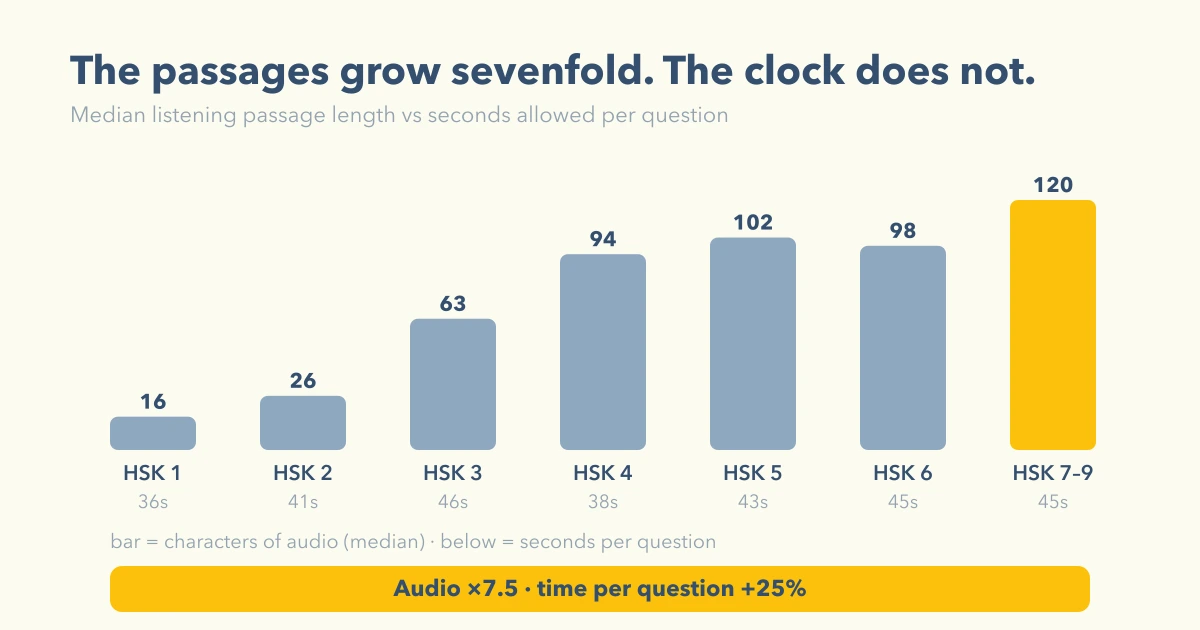
The passages grow sevenfold. The clock does not.
Take the 1,433 listening items in our own bank, built to the HSK 3.0 formats, and measure how long each audio passage actually is:
| Level | Passages | Median length | Longest |
|---|---|---|---|
| HSK 1 | 203 | 16 characters | 73 |
| HSK 2 | 250 | 26 | 110 |
| HSK 3 | 257 | 63 | 134 |
| HSK 4 | 228 | 94 | 184 |
| HSK 5 | 207 | 102 | 787 |
| HSK 6 | 172 | 98 | 259 |
| HSK 7–9 | 116 | 120 | 456 |
Now put that next to how much time the exam gives you per question:
| Level | Listening minutes | Items | Seconds per item |
|---|---|---|---|
| HSK 1 | 12 | 20 | 36 |
| HSK 2 | 17 | 25 | 41 |
| HSK 3 | 23 | 30 | 46 |
| HSK 4 | 20 | 32 | 38 |
| HSK 5 | 25 | 35 | 43 |
| HSK 6 | 30 | 40 | 45 |
| HSK 7–9 | 30 | 40 | 45 |
The passage gets 7.5 times longer. The clock gives you 25% more time.
That is the actual difficulty curve in HSK listening, and it is not a vocabulary curve. It is a processing-speed curve. At HSK 1 you have 36 seconds to handle sixteen characters — you can afford to translate in your head. At HSK 7–9 you have 45 seconds for a hundred and twenty. Translating is no longer physically possible.
Where the step change happens
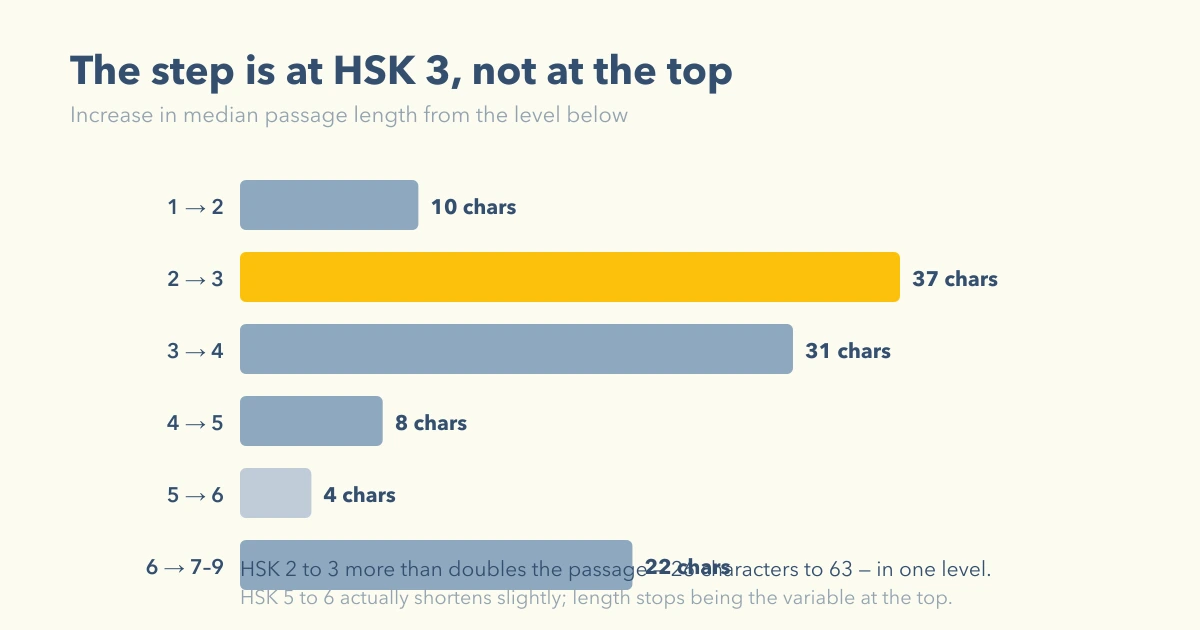
Look at the jump from HSK 2 to HSK 3: 26 characters to 63. Nothing else in the sequence comes close — it is a 2.4× increase in one level, while every other step is a fraction of that.
That is why HSK 3 listening is where people who were comfortable suddenly are not. The vocabulary requirement goes from 500 cumulative words to 1,000, which is manageable. The amount of speech you must hold in working memory while a question is asked more than doubles.
Notice also that HSK 5 to HSK 6 goes slightly down — 102 to 98 characters. Length stops being the variable at the top of the scale; density and vocabulary take over. The step you have to prepare for is at 3, not at 6.
Dialogue or monologue changes what is hard
The bank splits 834 dialogues against 599 monologues, and the balance shifts by level. At HSK 1 it is nearly even (99 dialogues, 104 monologues). By HSK 3 dialogues dominate (171 against 86).
They fail differently:
Dialogues demand that you track who is saying what. Miss a speaker change and the content is still intelligible but the answer is wrong, because most dialogue questions turn on attribution — what does the woman want, what will the man do.
Monologues demand sustained attention with no turn-taking to break the passage into chunks. Announcements, short talks, voicemail. Nothing signals structure except the content itself.
If your errors cluster in one type, the fix is different. Attribution errors mean practising with two-speaker audio and consciously tagging speakers. Sustained-attention errors mean practising longer single-voice passages, not harder ones.
What to practise, given that
Practise at the length you will face, not the difficulty. A 63-character passage of easy vocabulary at HSK 3 is better preparation than a 26-character passage of hard vocabulary. Length is the variable that is actually moving.
Stop translating, deliberately. This is the hard instruction and the important one. If you translate to your first language while listening, you are spending time you will not have from HSK 3 upward. Practising comprehension without translation feels worse at first and is the only path that scales.
Listen once. The exam plays audio once at most levels. Practice where you replay until you understand trains a skill the exam does not test, and hides the gap you actually have.
Answer from memory, not from replay. Hear the passage, then look at the question. That is the exam's order, and it forces you to hold content rather than scan for it.
Work on speed before vocabulary at HSK 3. Between levels 2 and 3 the bottleneck moves from "do I know this word" to "can I keep up". More flashcards will not fix keeping up.
A practice routine that matches the data
- One passage at your level, played once. No text, no replay.
- Answer from memory. Write down what you retained before checking.
- Then read the transcript and mark what you missed — was it a word you did not know, or a word you knew and did not catch in time? Those need different fixes and most people never separate them.
- Re-listen with the transcript, then without.
- Repeat at 1.2× speed once the level is comfortable. The exam does not speed up, but your margin does.
Free graded listening at every level, with transcripts and per-word audio, is at nestchinese listening practice — and if you are unsure which level to start from, the placement test takes five minutes.
Should you take notes?
At HSK 1 and 2, no. Sixteen to twenty-six characters is well inside what you can hold, and looking down to write costs you the next sentence.
From HSK 4 upward — passages near a hundred characters, several questions per passage — some form of note-taking helps most people. What works is not transcription but anchors: numbers, names, and the one word that marks a turn (但是, 不过, 因为). Three or four marks per passage, written without looking down.
The failure mode is trying to write sentences. Writing Chinese by hand is slower than listening to it, so an attempt at transcription leaves you behind almost immediately, and the notes you end up with are worse than the memory you sacrificed to make them.
The one thing to take away
HSK listening is not a vocabulary test with audio attached. It is a test of how much Chinese you can process per second, and the requirement more than doubles between HSK 2 and HSK 3 while the clock stays where it is. Prepare for the length, not the word list.
Siap memulai?
Temukan level HSK 3.0 Anda dalam 5 menit — gratis, tanpa kartu kredit.
Ikuti tes penempatan