
HSK levels explained: what each of the nine actually asks of you
2026-08-28 · 8 menit baca
"What HSK level am I?" is the wrong first question. The useful one is what each level actually asks you to do, because the gaps between them are wildly uneven. Two of the nine steps are roughly twice the work of the others, and nobody tells you which two until you are standing at the bottom of one.
The short version
- HSK 3.0 has nine levels in three bands: elementary (1–3), intermediate (4–6), advanced (7–9).
- The full ladder is 11,000 words, written with 3,088 distinct characters.
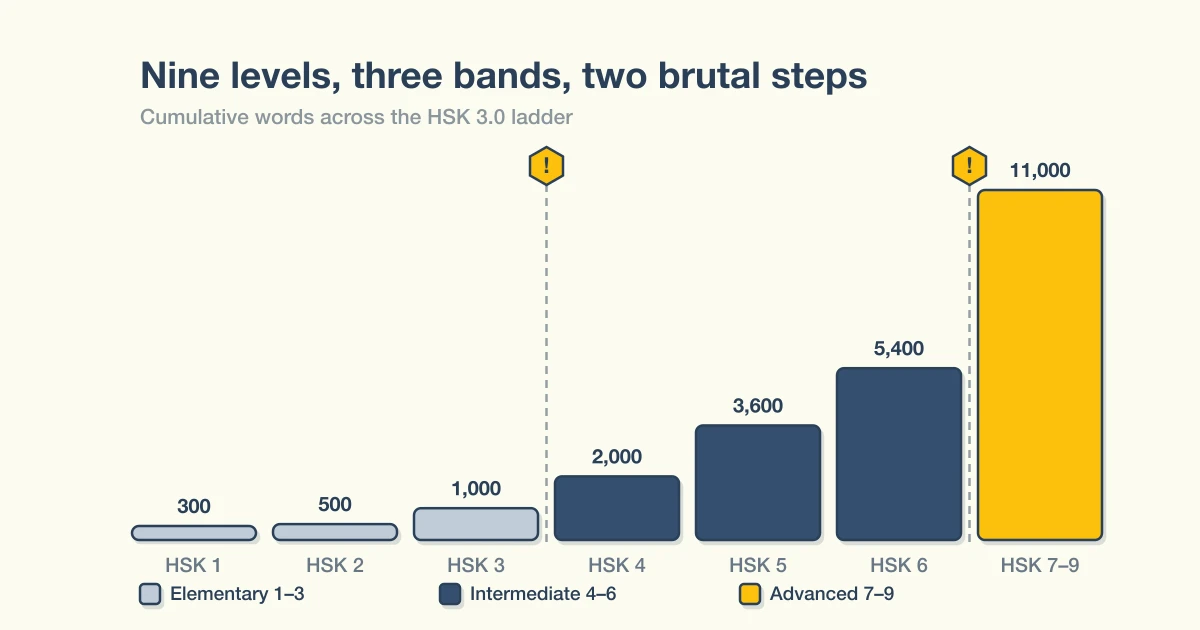
- The two brutal steps are 3 to 4 (vocabulary doubles) and 6 to 7–9 (one band adds more than the other six combined).
- Levels 1 and 2 together are only 500 words. You can clear them faster than you think.
- The advanced band adds 5,600 words but only 1,148 new characters: mostly recombination, not fresh symbols.
Nine levels, three bands
The old exam had six levels. The 2026 standard has nine, grouped into three bands. The grouping matters more than the numbering, because the three bands describe different kinds of ability, not just more of the same.
Elementary (1–3) is survival and simple sentences. Intermediate (4–6) is where you start reading paragraphs and holding opinions. Advanced (7–9) is a single band tested as one exam, aimed at people working or studying in Chinese.
Here is what the ladder looks like in numbers. Every figure below comes from counting the current word list, not from an estimate:
| Level | New words | Words so far | Distinct characters so far | Avg. characters per word |
|---|---|---|---|---|
| HSK 1 | 300 | 300 | 248 | 1.61 |
| HSK 2 | 200 | 500 | 371 | 1.64 |
| HSK 3 | 500 | 1,000 | 655 | 1.78 |
| HSK 4 | 1,000 | 2,000 | 1,096 | 1.83 |
| HSK 5 | 1,600 | 3,600 | 1,527 | 1.87 |
| HSK 6 | 1,800 | 5,400 | 1,940 | 1.91 |
| HSK 7–9 | 5,600 | 11,000 | 3,088 | 2.10 |
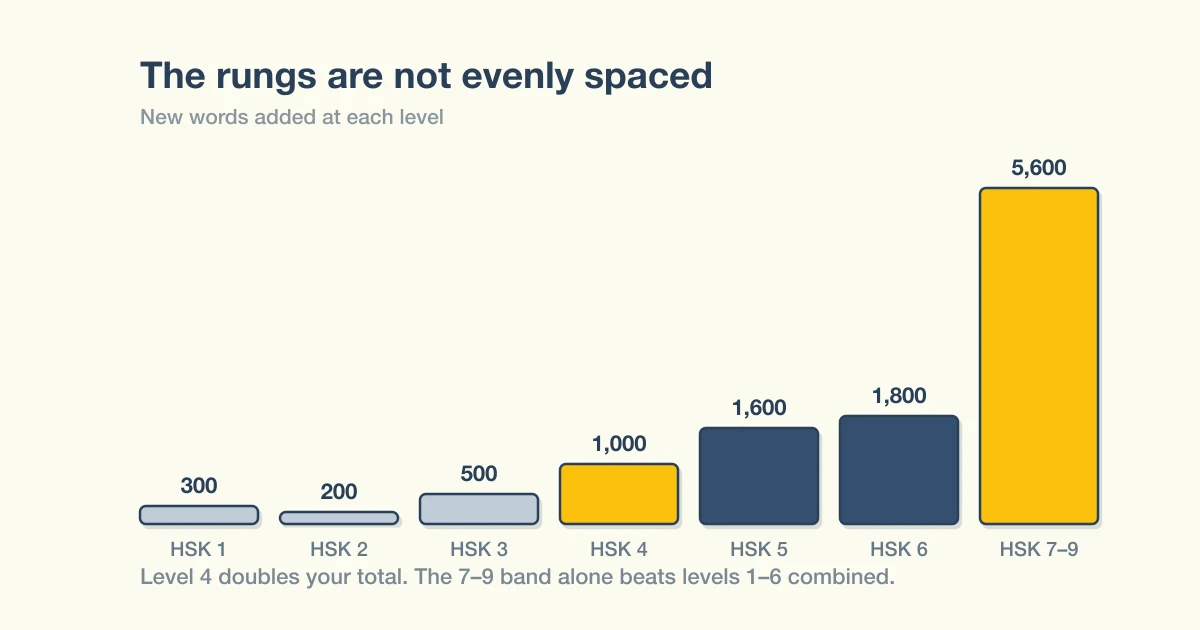
Read down the "new words" column and the shape jumps out. This is not a ladder with even rungs.
The two steps that are twice the work
HSK 3 to HSK 4 doubles your vocabulary. You arrive at level 3 knowing 1,000 words. Level 4 wants 2,000. Everything you learned to get through the first three levels, you do again in one step. Reading also changes character here: passages stop being single sentences and become paragraphs, so you are learning more words and tracking meaning across more text at once.
HSK 6 to the 7–9 band adds more than levels 1 through 6 combined. Five thousand six hundred new words against a cumulative 5,400. It isn't a step. It's a second staircase.
Everything else is comparatively gentle. Level 2 adds only 200 words. Level 3 adds 500. If you are stalling somewhere that is not 4 or 7–9, the problem is usually consistency rather than difficulty.
What you can actually do at each level
Word counts don't tell you how it feels. Roughly:
Levels 1–2 (500 words): you can handle the fixed scripts of daily life: greetings, numbers, ordering, asking where something is. Sentences are short and you rely on context. Pinyin support exists at the bottom, so you are not yet reading unaided.
Level 3 (1,000 words): the first level that feels like reading. Pinyin is gone. You can follow a short written message, describe your day, and hold a simple conversation that does not go off-script. This is where function words start deciding meaning, and where most self-taught learners first get stuck.
Level 4 (2,000 words): you can read a paragraph and get the gist without a dictionary. Conversations survive small detours. This is the level most people mean when they say they "speak some Chinese".
Levels 5–6 (3,600 to 5,400 words): text starts having opinions rather than just information. You can follow an argument, catch a concession, and disagree in Chinese without falling back on English word order. Writing tasks expect structure, not just correct sentences.
Levels 7–9 (11,000 words): specialist registers, long texts, speed. The band exists for people who need Chinese for work or academic study. Difficulty shifts from decoding to stamina.
Where your old HSK level lands
If you passed the old six-level exam, your number doesn't carry over cleanly. Roughly, old 1–2 sits near new 1–2, old 3–4 spreads across new 3–5, and old 5–6 maps into new 6–9. Treat that as orientation only. How the old and new levels compare goes into why a one-to-one mapping does not exist.
The character count grows far slower than the word count
One number in that table deserves its own paragraph. From level 1 to the full list, vocabulary grows 37 times over. The character set grows about 12 times, from 248 to 3,088.
That gap is the single most encouraging fact about advanced Chinese. The 7–9 band adds 5,600 words but only 1,148 characters you have not met. Most of what makes advanced text hard is old characters in new combinations, which is exactly why average word length climbs from 1.61 to 2.10 across the ladder.
The practical consequence: past level 4, time spent on how words combine pays better than time spent learning more standalone characters. How many characters you actually need covers where the useful ceiling sits.
How to tell which level you are really at
Self-assessment by word count is unreliable, because recognising a word on a list isn't the same as meeting it in a sentence. Two better checks:
Open the word list one level above where you think you are. Read fifty entries. If you stop and think more than five times, you are not at that level yet. You are at the one below, and that's useful to know before you book anything. Try HSK 3, HSK 4 or HSK 5.
Check which skill is dragging. Most people aren't evenly developed. Reading usually runs ahead, speaking behind. A single number hides that, and the skill you never practise is the one that sets your ceiling.
Frequently asked questions
How many HSK levels are there?
Nine, grouped into three bands: elementary (1–3), intermediate (4–6) and advanced (7–9). The 2026 standard replaced the old six-level system. The advanced band is tested as a single exam rather than three separate ones.
Which HSK level is the hardest jump?
Level 3 to 4, where vocabulary doubles from 1,000 to 2,000 words in one step. The move from 6 to the 7–9 band is larger in absolute terms (5,600 new words), but it is a whole band rather than a single level.
How many words do you need for each HSK level?
300 at level 1, then 500 cumulative by level 2, 1,000 by 3, 2,000 by 4, 3,600 by 5, 5,400 by 6, and 11,000 across the full nine levels. The full breakdown shows what each step adds.
Is HSK 4 good Chinese?
HSK 4 means about 2,000 words: enough to read a paragraph for gist and hold a conversation that wanders a little. It is the level most people mean by "conversational". Work and academic settings generally look at the advanced band.
One concrete step, today
Pick the level you believe you are at, open its word list, and read fifty entries with the audio on. Count how many times you stop.
Fewer than five, and you are ready to look one level up. More than ten, and the level below is where your time should go, which is worth finding out now rather than after a failed paper. If you would rather have it measured, the free level test takes about five minutes and reports both your band and which skill is holding it down.
Siap memulai?
Temukan level HSK 3.0 Anda dalam 5 menit — gratis, tanpa kartu kredit.
Ikuti tes penempatan