
Chinese to pinyin converters: the ten-second test most of them fail
2026-09-05 · 6 menit baca
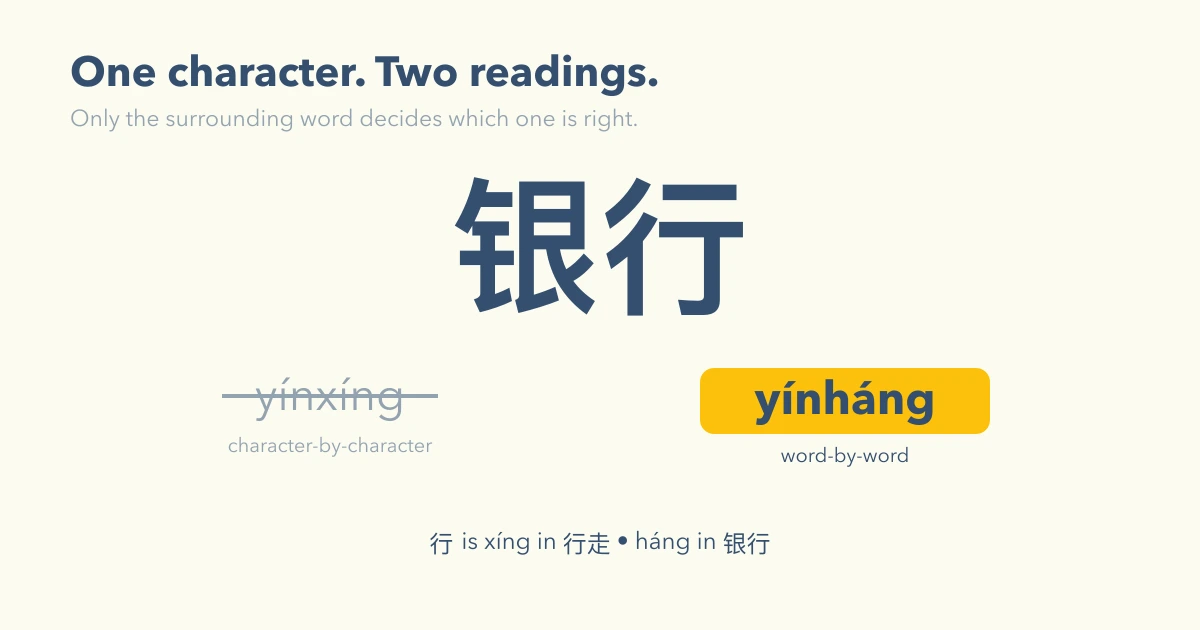
Copy this sentence and paste it into whichever pinyin converter you currently use:
他在银行工作,下班后听音乐。睡觉前,他觉得今天很快乐。
Then look at three things: the 行 in 银行, the two 乐, and the two 觉. If any of them come back with the same reading twice, the tool is looking up characters, not reading words — and it will keep making that mistake on everything else you paste into it.
What the sentence is doing
Nothing about it is unusual. It's an ordinary sentence about an ordinary day, built from HSK 1–3 vocabulary. What it contains is five readings that a character-level lookup cannot all get right at once:
| In the sentence | Correct reading | The other reading of that character |
|---|---|---|
| 银行 (bank) | yínháng | xíng, as in 行走 "to walk" |
| 音乐 (music) | yīnyuè | lè, as in 快乐 |
| 快乐 (happy) | kuàilè | yuè, as in 音乐 |
| 睡觉 (to sleep) | shuìjiào | jué, as in 觉得 |
| 觉得 (to feel) | juéde | jiào, as in 睡觉 |
Read the last four rows again. 乐 appears twice in one sentence and needs a different reading each time. So does 觉. A tool that stores one pronunciation per character is not merely likely to slip here — it is structurally incapable of getting both right. It has to pick, and half the time it picks wrong.
The correct output is:
tā zài yín háng gōng zuò, xià bān hòu tīng yīn yuè. shuì jiào qián, tā jué de jīn tiān hěn kuài lè.
Why so many tools fail it
A character-to-pinyin table is easy to build and small enough to ship in a web page. Chinese has roughly 3,000 characters in common use; give each one its most frequent reading and you'll be right most of the time. Most of the time is the problem.
Doing better means splitting the text into words before looking anything up — deciding that 银行 is one unit and 行走 is another, then taking the reading from the word rather than the character. That requires a word list with pronunciations attached, and it requires segmentation. Both are more work than a lookup table, which is why plenty of free converters skip them.
How many characters actually behave this way
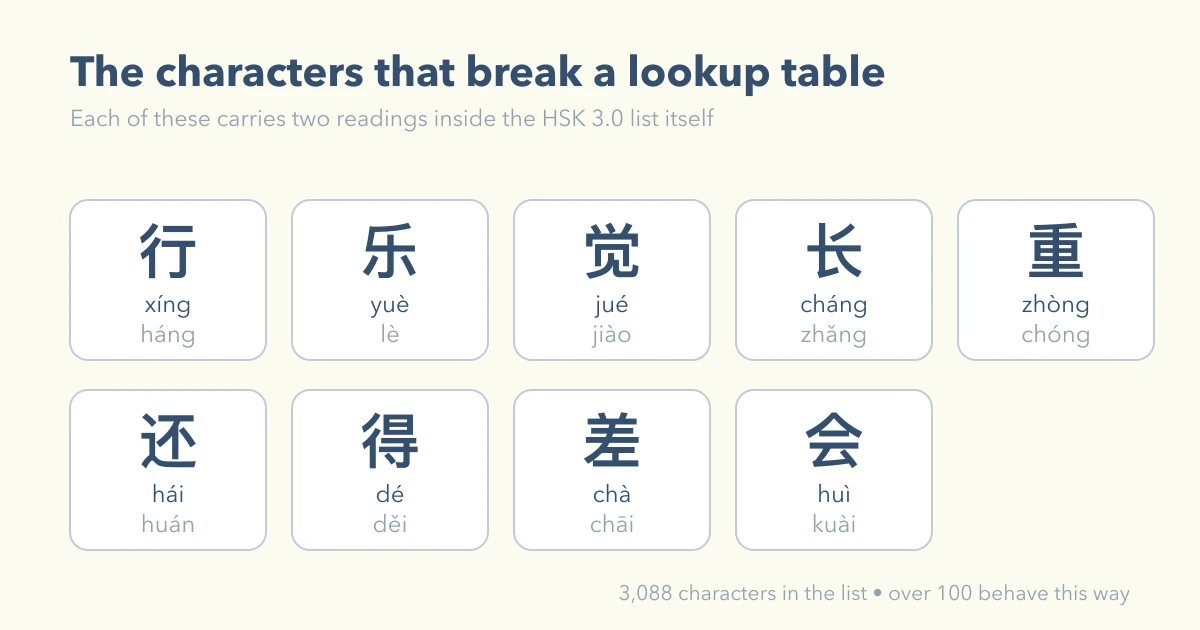
The HSK 3.0 vocabulary uses 3,088 distinct characters. Line up each word's pinyin with its characters across all 11,000 entries and more than a hundred of those characters turn out to carry two readings — not counting neutral-tone variants or tone sandhi, which are a separate matter. Roughly one character in thirty.
One in thirty sounds survivable until you see which ones they are. 行, 乐, 觉, 长, 重, 还, 得, 差, 会 all carry two readings inside the HSK list itself:
- 长 — cháng in 长期 (long-term), zhǎng in 校长 (headteacher)
- 重 — zhòng in 重要 (important), chóng in 重复 (to repeat)
- 还 — hái in 还是 (still), huán in 归还 (to give back)
- 会 — huì in 开会 (to hold a meeting), kuài in 会计 (accountant)
None of these is obscure. They sit in the first few hundred characters any learner meets, and they turn up constantly. A converter that mishandles them is wrong in exactly the sentences you are most likely to paste into it.
The trap this sets for a learner
Getting a reading wrong on screen is a small error. Getting it wrong in your memory is not.
If you meet 音乐 early and your converter tells you yīnlè, you will say yīnlè. You'll go on saying it until a teacher or a native speaker stops you, and by then the wrong reading has been rehearsed a few hundred times. Unlearning a pronunciation you have practised is considerably harder than learning it once correctly — this is the same reason stroke order matters more than it looks.
Tone marks make this worse, not better. A converter that outputs a bare yinle at least looks unfinished. One that outputs a confident yīnlè, with the diacritics neatly placed, looks authoritative. Precision of presentation says nothing about correctness of content.
What no converter can do for you
Three limits are worth knowing before you rely on any of them, ours included.
Tone sandhi is not shown. 不 and 一 shift tone before certain syllables, and two third tones in a row change the first. Dictionary readings are what you should memorise — but they are not what comes out of a speaker's mouth. Every converter that gives you clean citation tones is giving you the written convention, not the sound.
Names are guesswork. Personal and place names use readings that a general word list has no reason to contain, and some surnames take a reading found nowhere else.
Rare and literary readings are usually missing. A word list built for a proficiency exam covers the vocabulary of that exam. Classical usage falls outside it.
A tool that admits these things is more useful than one that quietly gets them wrong.
Run the test
Our Chinese to pinyin converter segments text into words first and takes each reading from the word's own entry in the 11,000-word HSK 3.0 list, so 银行 and 行走 come out differently because they are different entries — not because a rule was written for them. On the sentence above it returns all five readings correctly, and it tells you how many characters in your text it actually found, instead of quietly guessing at the rest.
Paste the same sentence into whatever you use now. Ten seconds is enough to find out whether it reads Chinese or just looks characters up.
Siap memulai?
Temukan level HSK 3.0 Anda dalam 5 menit — gratis, tanpa kartu kredit.
Ikuti tes penempatan