
Chinese character practice sheets: choosing what goes on them
2026-09-08 · 6 menit baca
Printable practice sheets are the most downloaded thing in Chinese learning and the least thought-about. Most people print a grid, fill it with whatever characters they are on this week, and copy each one twenty times.
The grid is fine. The character selection is where the hours are won or lost, and it can be decided with data rather than by whatever the textbook happened to introduce.
Some characters pay back a hundred times
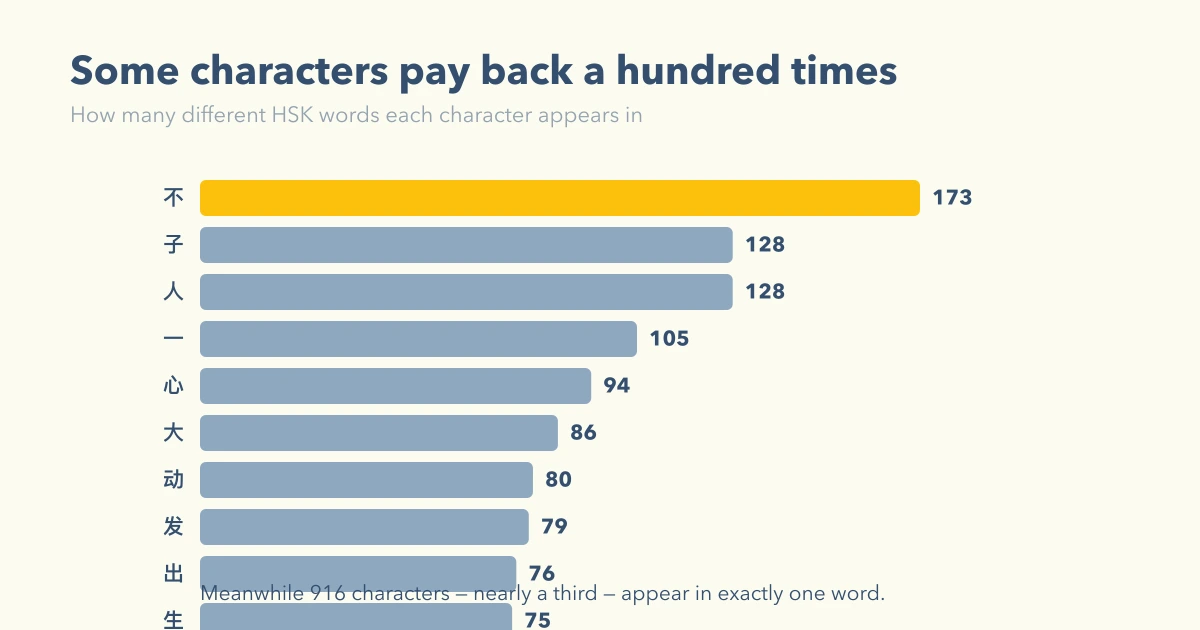
Count how many distinct HSK words each character appears in — that is the return on learning to write it:
| Character | Appears in |
|---|---|
| 不 | 173 words |
| 子 | 128 |
| 人 | 128 |
| 一 | 105 |
| 心 | 94 |
| 大 | 86 |
| 动 | 80 |
| 发 | 79 |
| 出 | 76 |
| 生 | 75 |
| 地 | 71 |
| 力 | 70 |
Learning to write 不 is not learning one character. It is learning to hand-write part of 173 words you will meet across the whole syllabus.
Now the other end. Of the 2,857 characters used in HSK example sentences, 916 — almost a third — appear in exactly one word. 爸 only in 爸爸. 饺 only in 饺子. 苹 only in 苹果. Writing those twenty times each buys you exactly one word.
That is the entire selection problem, and it is a factor of a hundred wide.
What to actually put on the sheet
Start with the connectors and the frequent components. 不, 一, 人, 大, 子, 心, 生, 出, 地, 力 are not glamorous — they are structural. They appear inside other characters as well as beside them, so writing them well makes the characters that contain them easier to write too.
Put single-use characters on the sheet only when the word matters. If you need to write 苹果, practise it as 苹果. Giving 苹 its own row is paying character-level effort for word-level value.
Practise in words, not in isolation. A row of twenty 不 teaches your hand the shape. A row of 不好, 不要, 不能, 不同 teaches the shape and the spacing — and spacing between characters is where handwritten Chinese most obviously reads as foreign.
How many characters is a sheet worth?
Handwriting is slow. It is worth knowing what the schedule buys before committing to it.
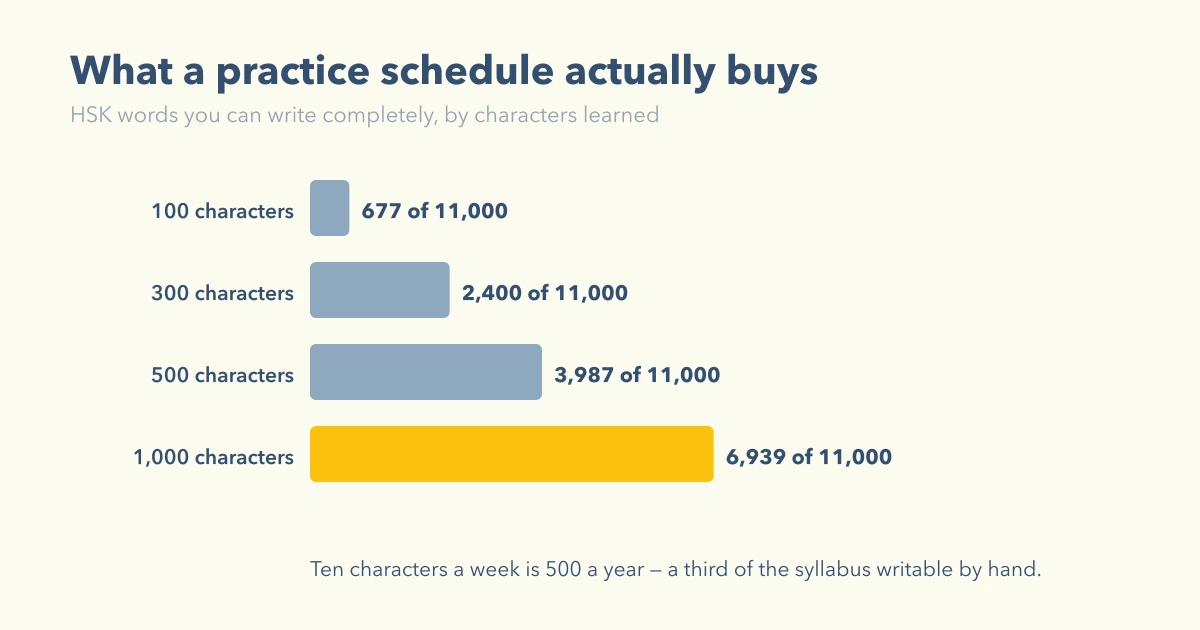
Learning the thousand most frequent characters lets you fully write 6,939 of the 11,000 HSK words (63%). The top 500 gets you 3,987 (36%). The top 300 gets 2,400 (22%).
The curve is the same one that governs reading coverage, and it has the same implication: the first few hundred characters are worth an enormous amount of deliberate practice, and somewhere past a thousand the marginal hour buys very little.
For handwriting specifically the cut-off is even earlier than for reading, because you can read a character you cannot write. Most learners never need to write the back half of the syllabus by hand at all.
Stroke order matters more on a sheet than on a screen
Copying a character with the wrong stroke order produces something that looks approximately right and is wrong in a way that compounds. Handwriting recognition fails on it, your speed plateaus, and the muscle memory has to be unlearned rather than extended.
The rules are few, and they cover almost everything: top before bottom, left before right, horizontal before crossing vertical, outside before inside, and close the box last. Beyond those, watch the animation once before the first repetition rather than after the twentieth.
Our stroke order tool animates any character and generates printable grid sheets, so you can watch the order and then practise it on the same page.
The grid, and how many repetitions
The paper matters less than the selection, but two things about it are worth getting right.
Use a grid with guide lines, not plain squares. The standard 田字格 divides each cell into quarters with a cross. Its job is not decoration — it gives you a reference for where the components sit relative to each other, which is the thing beginners get wrong. Characters written in an empty box drift: the left component creeps too large, the right one gets squeezed. With a cross in the cell you can see it happening.
Five to eight repetitions, then stop. The twentieth copy of a character is drawn by your hand while your attention is elsewhere, and attention is what encodes. Beyond roughly eight the marginal repetition teaches almost nothing, and the time is better spent on a second character or on using the first one in a word.
The exception is a character you keep getting structurally wrong — wrong proportion, wrong stroke order. There, more repetitions do help, because you are overwriting an existing motor habit rather than forming a new one.
A schedule that respects the curve
Ten characters a week, chosen by reach. Not in the order your textbook introduces them — by how many words each one appears in. Ten a week is 500 in a year, which is 36% of the syllabus writable by hand.
Five repetitions, then use it. Twenty repetitions of a character you will not write again this month is worse than five repetitions plus writing it inside three real words. Retrieval spaced out beats repetition massed together, and this is one of the most consistently replicated findings in learning research.
Come back after a week, not after an hour. A sheet filled perfectly today and never revisited is a sheet wasted. The second and third sittings are where the character actually lands.
Stop writing characters you only read. Somewhere around HSK 4 the sensible split is: read everything, write the frequent core. Almost nobody needs to handwrite 嚣.
When you can read it but cannot write it
This is normal and it is not a gap you always need to close.
Recognition and production are separate abilities with separate decay curves. You will be able to read several thousand characters while being able to write a few hundred, and for most learners that ratio is correct — typing uses pinyin, so the characters you must produce by hand are a small subset of the ones you must recognise.
The subset worth being able to write is: the frequent core (the high-reach characters above), anything you need for an exam that has a handwriting section, and your own name and address. Everything else can stay in recognition, and pretending otherwise turns handwriting from a useful skill into an open-ended obligation.
The one-line version
Print the grid, but choose what goes on it by how many words each character appears in — not by what came next in the book. Between 不 at 173 words and 苹 at one, the gap in what an hour of copying buys you is a factor of a hundred and seventy.
Siap memulai?
Temukan level HSK 3.0 Anda dalam 5 menit — gratis, tanpa kartu kredit.
Ikuti tes penempatan