
Why studying HSK in your own language works better
2026-07-13 · 6 min de lectura
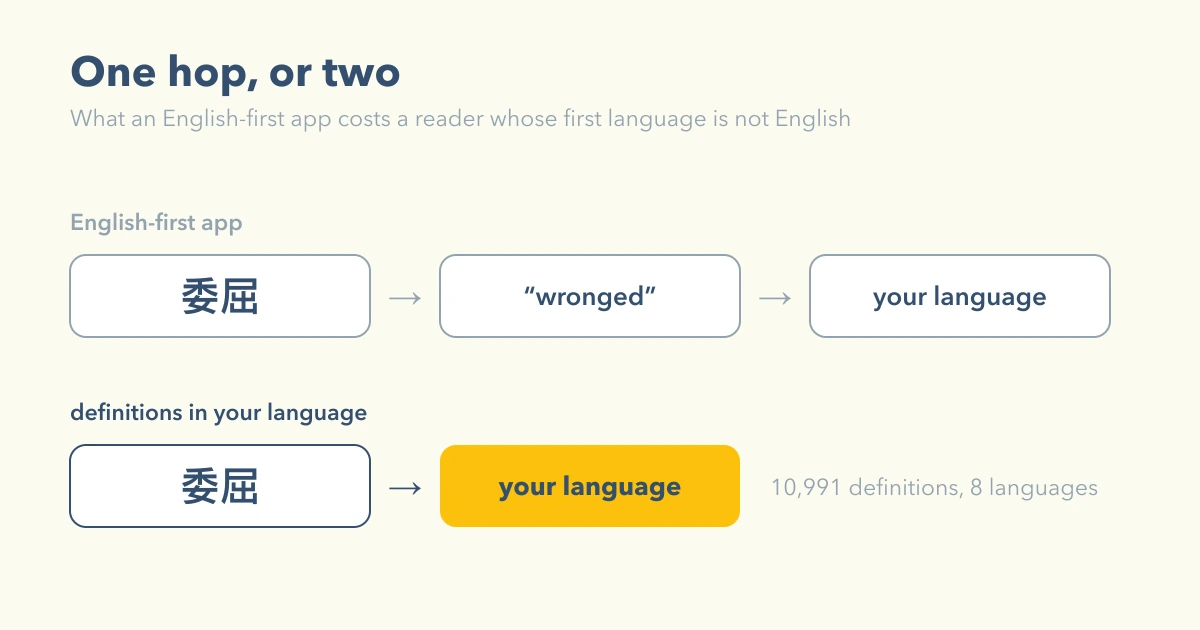
If your first language is Indonesian, Thai or Arabic and your Chinese app explains everything in English, every definition you read takes two hops instead of one: Chinese → English → the language you actually think in. You pay that tax on every gloss, every grammar note, every explanation of a mistake, and none of it is Chinese.
Most people absorb the cost without noticing, because they can read English. Being able to read a language and thinking in it are different things, and the difference shows up exactly where learning happens.
Why the second hop is expensive
The relevant idea from instruction research is cognitive load: working memory is small and shared. Anything spent on decoding the explanation is not available for the thing being explained.
When a definition arrives in your strongest language it is understood without effort — the meaning is simply there. When it arrives in your second language, some of your attention goes to the wrapper instead of the content. For a fluent English reader that cost is small but not zero; for someone who reads English carefully rather than automatically, it is substantial. Either way it lands on every single item, which is what makes it add up.
The effect is largest in the two places that matter most:
Error explanations. The moment after a mistake is when correction sticks. An explanation you have to parse twice arrives after the moment has passed.
Abstract vocabulary. Concrete words survive the second hop — 猫 is cat is kucing. Abstract ones don't. Chains like 委屈 → "wronged; to feel wronged" → your language lose precision at each step, and the words that need the most precision are the ones that get the least.
What "in your language" has to cover
The phrase gets used loosely. Menu labels in nine languages is not the same as learning in nine languages. Three layers matter, in ascending order of difficulty:
The interface — buttons, navigation, settings. Easy, and where most apps stop.
The content — every word's definition. This is the hard part, because it means translating a full dictionary rather than a screenful of labels. It is also where nearly all the value sits: the definition is the thing you read eleven thousand times.
The direction — Arabic is right-to-left, and a layout that merely mirrors its margins produces broken punctuation and numbers running the wrong way inside sentences.
For reference, on NestChinese the interface is 579 strings in each of nine languages, and the word definitions are 10,991 entries translated into each of the eight non-English languages — not fallbacks, not machine output left unchecked. Arabic runs in a proper RTL layout rather than a mirrored one.
The limit worth knowing before you switch
Example sentences carry a Chinese sentence, its pinyin, and an English translation. That layer is not translated into the other eight languages yet.
In practice this matters less than it sounds — you meet the word's definition in your language first, and the example is there to show the word doing a job in a sentence, which the Chinese itself mostly conveys. But it is a real gap, and you should know about it rather than discover it.
Does it actually change anything?
Honestly: it depends on how you read English.
If English is effectively a second first language for you, the gain is modest — you may prefer English definitions simply because Chinese-learning material in English is more abundant.
If you read English deliberately rather than automatically, the gain is large and shows up immediately in how much you get through in a session. That is also the group most poorly served by the existing market, because almost every serious Chinese-learning tool is built English-first.
Settle it in one session
This is not worth deciding from a description. Set the interface to your language, open any word, and read the definition — 快乐 or any word you already know is a fair test, because you can judge the translation rather than guess at it.
Then run a few minutes of the daily plan: instructions, definitions and the explanation attached to every mistake all arrive in the language you set. Switching back takes one tap, which makes the comparison cheap. Free to start, no account needed to browse the word lists.
¿Listo para empezar?
Descubre tu nivel de HSK 3.0 en 5 minutos: gratis y sin tarjeta.
Hacer el test de nivel