
HSK 7–9 explained: one band, bigger than everything below it
2026-09-08 · 6 min de lectura
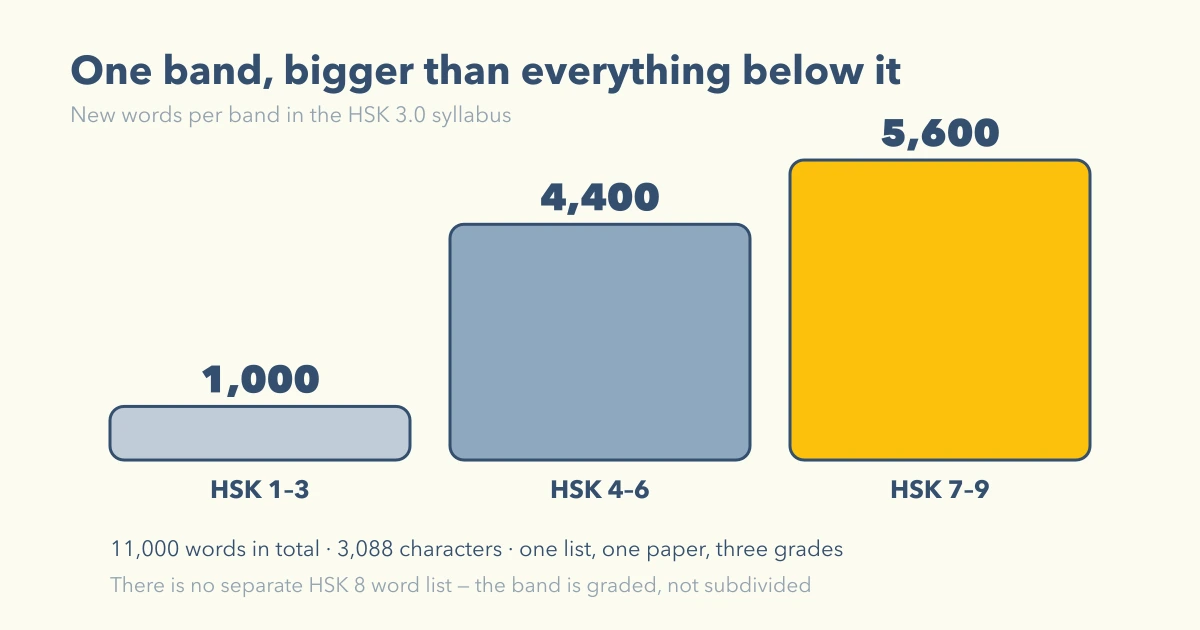
Levels 7, 8 and 9 are the part of HSK 3.0 that most learners have never looked at, and the part most misdescribed. There is no separate HSK 8 word list. There is no HSK 7 exam and a harder HSK 8 exam. The advanced band is one syllabus and one paper, and the three numbers refer to how well you do on it.
Here is what it contains.
One list, bigger than everything below it
| Band | New words | Cumulative |
|---|---|---|
| HSK 1–3 | 1,000 | 1,000 |
| HSK 4–6 | 4,400 | 5,400 |
| HSK 7–9 | 5,600 | 11,000 |
The advanced band on its own is larger than the six levels beneath it put together. That single fact reframes the whole scale: HSK 6, the old ceiling, is slightly less than half way up the new one.
It also adds 1,148 new characters — from 1,940 at HSK 6 to 3,088 across the full syllabus.
What kind of vocabulary it is
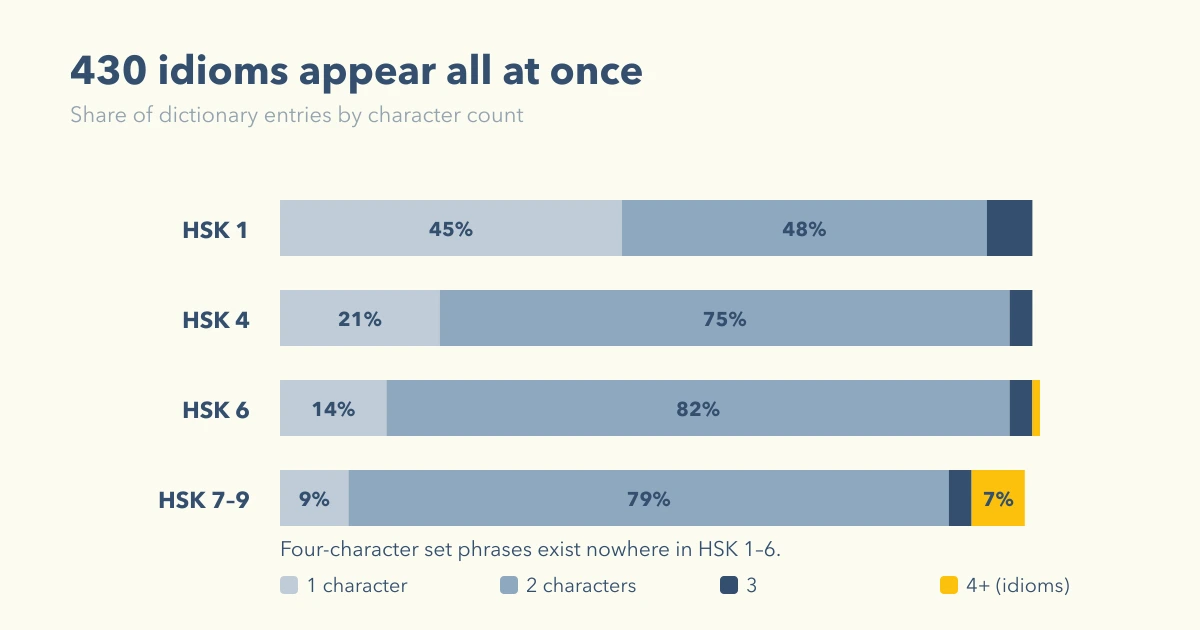
Count how many characters each entry has, and the advanced list is a different shape from everything below:
| Level | Single character | Two characters | Four or more |
|---|---|---|---|
| HSK 1 | 45% | 48% | 0% |
| HSK 4 | 21% | 75% | 0% |
| HSK 6 | 14% | 82% | ~1% |
| HSK 7–9 | 9% | 79% | 7% |
That 7% is 430 four-character items, almost all set idioms — 成语 — and they exist nowhere in the first six lists. This is the band's signature: a category of vocabulary that appears all at once, whose meaning cannot be assembled from its parts, and which has to be learned as fixed phrases.
Nine percent single characters, down from 45% at HSK 1. The early syllabus hands you building blocks; this one hands you assemblies.
The exam is a different shape too
| Level | Minutes | Items | Sections |
|---|---|---|---|
| HSK 1 | 40 | 40 | listening, reading |
| HSK 4 | 85 | 70 | + writing |
| HSK 6 | 125 | 82 | |
| HSK 7–9 | 210 | 91 | + translation |
Three and a half hours. Item count is only 11 higher than HSK 6, so the extra 85 minutes are not extra questions — they are longer ones.
The breakdown:
- Listening 30 minutes, 40 items — the same as HSK 6
- Reading 60 minutes, 47 items
- Writing 55 minutes, 2 items
- Translation 35 minutes, 2 items
A translation section appears on the paper only here. The standard defines translation as an ability from level 4 upward, but it becomes its own timed section, with its own marks, only in the advanced band. It is also the one thing nothing below prepares you for: reading comprehension and writing fluency are both necessary and neither is sufficient, because translation tests the join between them.
Two items in 55 minutes for writing, two in 35 for translation. Four pieces of extended production decide nearly half the paper's time.
What actually gets harder — and what does not
Some of it is less dramatic than the level numbers suggest.
Sentence length barely moves. Median example-sentence length runs 9 characters at HSK 1 and 11 at HSK 7–9. Two characters across the entire syllabus.
The characters barely get harder. In advanced example sentences, 47% of character tokens are still HSK 1–2 characters and 83% are HSK 1–4. Only about 5% belong to the advanced band itself.
Listening passages do grow — median 16 characters at HSK 1 against 120 at HSK 7–9 — but the sharpest jump is much earlier, between HSK 2 and 3.
So the advanced band is not made of long sentences full of rare characters. It is made of ordinary characters in combinations you have not met, plus 430 idioms, plus two skills — extended writing and translation — that are qualitatively different from anything below.
The 430 idioms
They deserve their own treatment, because nothing else in the syllabus behaves like them.
A 成语 is a fixed four-character phrase, usually with a story or a classical text behind it, whose meaning is not recoverable from the characters. Knowing all four characters of 画蛇添足 tells you it involves drawing, a snake, adding and feet; it does not tell you it means to ruin something by overdoing it. The composition is opaque by design.
Three consequences for study:
Decomposition does not help. The strategy that carries you through most of Chinese vocabulary — read the parts, infer the whole — fails completely here. These have to be learned as units, with their meaning attached, the way you learn an English idiom.
They cluster in written registers. Formal writing, editorials, speeches. You will meet them far more per thousand characters in a newspaper than in a conversation, which is exactly why they arrive alongside the exam's translation and extended-writing sections.
Recognition is worth far more than production. Using a 成语 slightly wrong is more conspicuous than not using one at all, because they carry register. Being able to read all 430 is a realistic goal; deploying them in your own writing is a much later one, and not required to pass.
The practical order is: learn them as phrases, from context, with the story attached where there is one — the story is what makes an otherwise arbitrary four-character string stick.
Who it is actually for
Not most learners, and that is fine. HSK 6 already represents a genuinely functional level of Chinese. The advanced band exists for people who need Chinese professionally or academically — interpreting, translation, graduate study in Chinese, work where you draft rather than only read.
If you are aiming here, the shift is from breadth to production. Everything up to HSK 6 rewards recognition. This band tests whether you can produce — two writing pieces and two translations, unaided, under time.
The idioms are the trap. 430 items that cannot be guessed, cannot be decomposed, and are heavily weighted in written registers. They are the one part of this syllabus where rote learning is genuinely the right method.
Where to start looking
The full list is browsable — all 5,600 words of HSK 7–9, with pinyin, stroke order and audio on every entry. Reading down the first page is the fastest way to find out whether this band is your next step or a later one.
And if you are coming from an old HSK 6 certificate: 61% of the old HSK 6 vocabulary now sits in this band. You may already be further into it than the level numbers suggest.
¿Listo para empezar?
Descubre tu nivel de HSK 3.0 en 5 minutos: gratis y sin tarjeta.
Hacer el test de nivel