
The hardest Chinese characters are not the ones with the most strokes
2026-09-08 · 7 min de lectura
Ask which Chinese character is hardest and you get 龘 (three dragons, 48 strokes) or biáng, the noodle character with 58. Both are real, both are fun, and neither will ever appear in anything you have to read. They are trivia, not difficulty.
The useful question is narrower: within the 3,088 characters the HSK 3.0 syllabus actually uses, which ones cost the most to learn? That has an answer, and it is not the one stroke counts suggest.
Complexity is not where the difficulty is
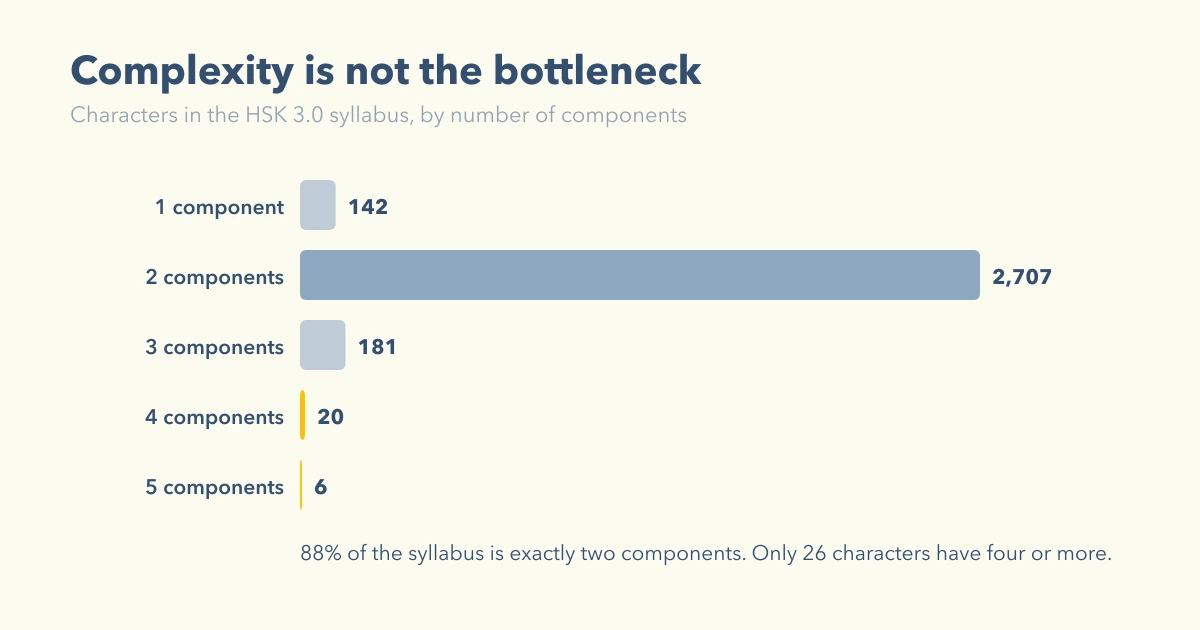
Break every character in the syllabus into its components and the distribution is remarkably flat:
| Components | Characters |
|---|---|
| 1 (indivisible) | 142 |
| 2 | 2,707 |
| 3 | 181 |
| 4 | 20 |
| 5 | 6 |
Eighty-eight percent of the syllabus is exactly two components. The genuinely elaborate characters — four or more parts — number 26 out of 3,088, less than one percent.
The six five-component characters are 德, 寝, 嚣, 噩, 器 and 丽. Look at where they sit: 丽 is HSK 4, 器 is HSK 5, 德 is HSK 6. They arrive early enough that structural complexity clearly is not what the syllabus is grading on, and learners rarely report them as problems. 器 is four mouths around a dog. Once you have seen that, you have it.
Where it actually is: characters made of the same parts
Here is the finding that reorganises the question. Across the syllabus there are 34 groups of characters built from exactly the same components, differing only in how those components are arranged, sized or positioned:
| Same components | Characters |
|---|---|
| 一 + 木 | 未 末 本 朱 |
| 丶 + 王 | 主 玉 |
| 丿 + 小 | 乐 少 |
| 丿 + 乙 | 九 几 |
| 人 + 冂 | 内 贝 |
| 刂 + 巾 | 制 帅 |
| 力 + 口 | 加 另 |
| 丶 + 勹 | 勺 夕 |
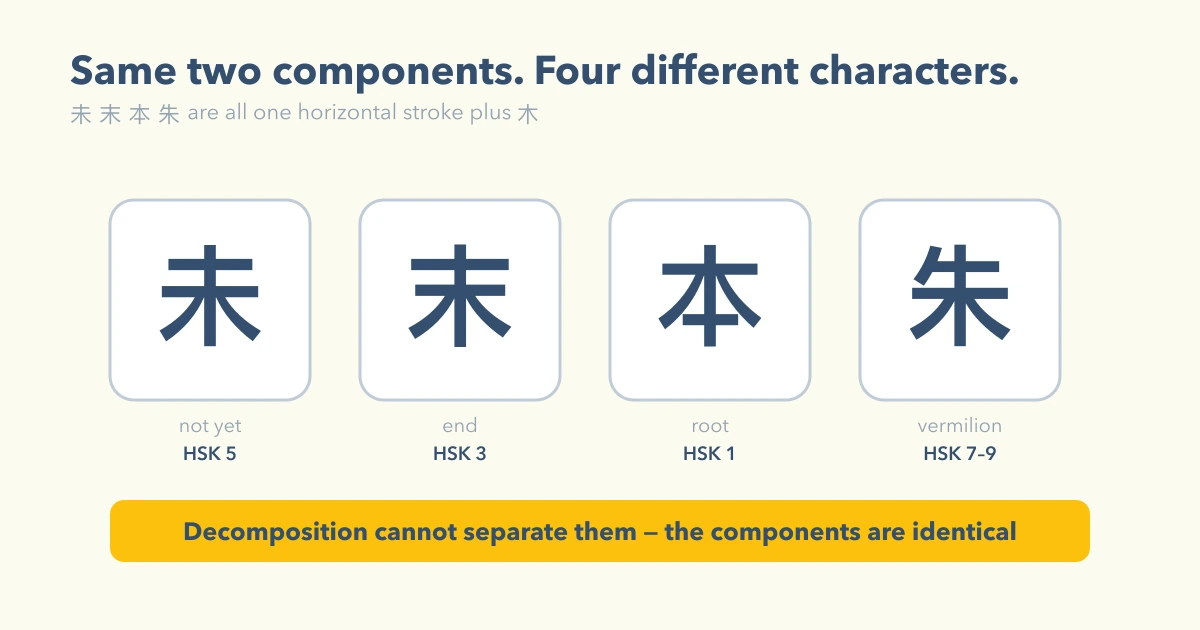
未, 末, 本 and 朱 are all one horizontal stroke plus 木. Nothing else. What separates not yet, end, root and vermilion is where that horizontal sits and how long it is relative to the one below — 末 carries the longer line on top (the far end of the tree), 未 the shorter one (not yet grown out), 本 puts it at the foot (the root).
No amount of component knowledge helps here, because the components are identical. Decomposition — the strategy that makes almost every other character tractable — is exactly the strategy that fails on this set.
And the syllabus makes it worse by scattering them. Those four characters arrive at HSK 1 (本), HSK 3 (末), HSK 5 (未) and HSK 7 (朱) — spread across the entire nine-level scale, potentially years apart. By the time 未 shows up you have had 末 filed away for a year under "the 木 one with a line on top", and the two collide. The same spread hits the other sets: 乐 is HSK 2 and 少 is HSK 1; 内 is HSK 4 and 贝 is HSK 5; 加 is HSK 3 and 另 is HSK 4.
Nothing in a level-ordered syllabus can prevent this, because the ordering is by usefulness and the confusion is by shape. It is a gap you have to close yourself.
The second cost: characters you meet once
The other kind of hard is not visual at all. Of the 2,857 characters that appear in HSK example sentences, 916 — nearly a third — appear in exactly one word in the entire syllabus.
爸 exists for 爸爸. 饺 exists for 饺子. 苹 exists for 苹果. Learning them as characters, with their own flashcard and their own review schedule, is close to wasted effort: they will never recombine, so the investment has no second payout.
Now intersect the two problems. 51 characters in the syllabus have three or more components and appear in only one word. These are the genuinely expensive ones — elaborate to write, and with no leverage to recoup the cost:
嚣, 噩, 燕, 徽, 兹, 亭, 鹰, 辫, 蹋, 贮, 萨 — plus 齿, 骂 and 铅, which arrive as early as HSK 3 and 5.
If a character is going to be hard, this is the profile: complicated and isolated. A complicated character that recombines widely (器 appears across 机器, 电器, 机器人, 瓷器) pays for itself. One that does not is a tax.
How to actually separate a confusable set
The sets are finite — 34 of them across the whole syllabus — so this is a bounded problem, not an endless one. Three things work:
Contrast them side by side, out loud, with the difference named. Not "未 means not yet" but "未 has the shorter line on top — the tree has not grown past it yet; 末 has the longer one — that is the far end of the branch." A stated difference is recallable; a felt one is not.
Use them in a phrase you already know. 周末 (weekend) fixes 末. 未来 (future) fixes 未. 本子 (notebook) fixes 本. Once each character has one high-frequency word attached, the set stops being four shapes and becomes four words you can already say.
Test in the confusable direction. Reviewing 未 alone will not catch the problem, because in isolation you will get it right. The test that finds the weakness is being shown 未 and 末 together and having to say which is which — that is the discrimination the reading task actually requires.
What this changes about how you study
Stop grading characters by stroke count. It correlates with almost nothing that matters. Two components covers 88% of the syllabus, and the count tells you nothing about whether you will confuse it with something else.
Learn confusable characters in their sets, deliberately. 未 and 末 met two levels apart will blur. Met together, with the contrast made explicit, they hold — memory interference is worst between items that are similar in form and were encoded separately, which is precisely what a level-ordered syllabus produces. When you meet one member of a set, go and fetch the others rather than waiting for the syllabus to deliver them.
Check whether a character recombines before investing in it. If it appears in one word, learn the word and let the character come along for the ride. Our radical table shows which components are productive; a character built from productive parts is worth knowing as a character.
Treat one-word characters as parts of their word. 铅 (HSK 3) exists for 铅笔, 齿 (HSK 5) for 牙齿, 骂 (HSK 5) is a word on its own. Giving each its own flashcard, review schedule and mnemonic is paying character-level costs for word-level value.
Expect the difficulty to move. In the first few months it is genuinely visual — everything looks alike because you have no components yet. By HSK 4 it has shifted to the confusable sets and the isolated characters. Study advice aimed at month one stops applying, and most of it is aimed at month one.
The short answer
The hardest character in HSK 3.0 is not 德 or 嚣. It is 未 — or 末, depending on which one you got wrong last time. It has two components, six strokes, arrives at an intermediate level, and shares its entire structure with three other characters you also need. Nothing about it looks difficult, which is precisely the problem.
¿Listo para empezar?
Descubre tu nivel de HSK 3.0 en 5 minutos: gratis y sin tarjeta.
Hacer el test de nivel