
HSK 3.0 vs the old HSK: where does your old level land?
2026-07-13 · 7 دقيقة قراءة
"I passed HSK 4" used to be a complete sentence. Under the 2026 standard it isn't, because the old six levels and the new nine were drawn on different scales — and not by shifting everything up one notch, which is what most people assume.
We can be more precise than a rough mapping. Below is what actually happened to the words themselves.
Where the old words went
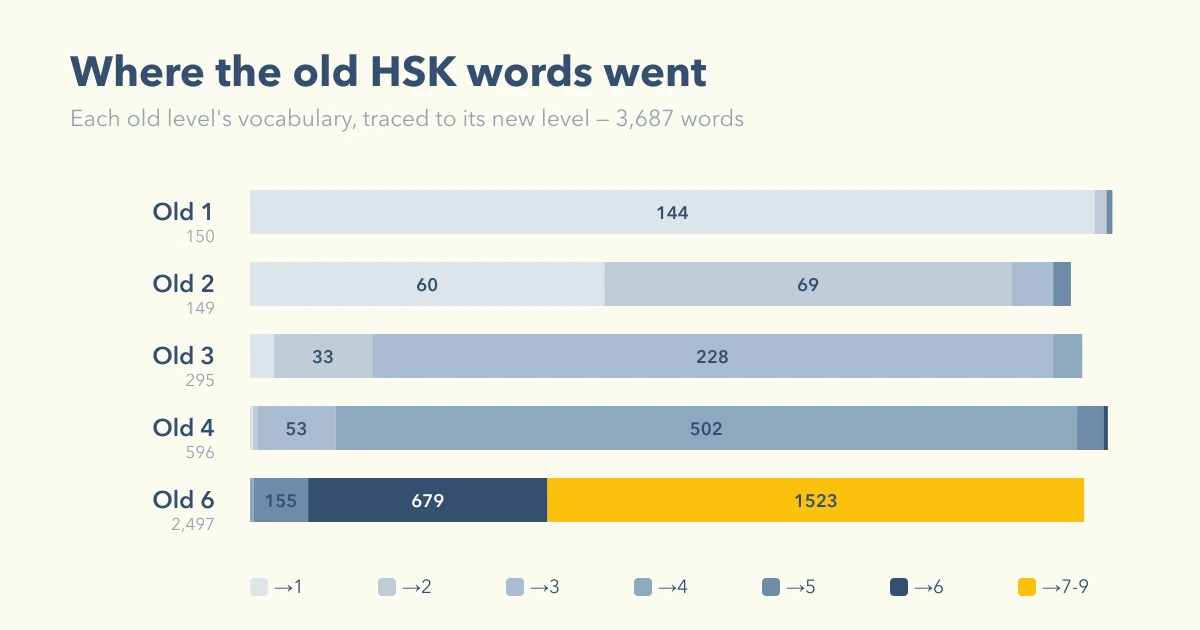
The old syllabus and the new one share 3,687 words that can be traced entry by entry. Tracking each one from its old level to its new one gives this:
| Old level | Words traced | → new 1 | → new 2 | → new 3 | → new 4 | → new 5 | → new 6 | → new 7–9 |
|---|---|---|---|---|---|---|---|---|
| Old 1 | 150 | 144 | 2 | — | — | 1 | — | — |
| Old 2 | 149 | 60 | 69 | 7 | — | 3 | — | — |
| Old 3 | 295 | 8 | 33 | 228 | 10 | — | — | — |
| Old 4 | 596 | 2 | 3 | 53 | 502 | 18 | 3 | — |
| Old 6 | 2,497 | — | — | — | 10 | 155 | 679 | 1,523 |
Two things jump out, and they point in opposite directions.
The bottom got easier. Forty percent of old HSK 2 vocabulary — 60 words out of 149 — is now HSK 1. Old level 3 lost 41 words downward too. The elementary band was re-sorted toward what beginners actually meet first.
The top got much harder. Of the 2,497 old HSK 6 words, 1,523 (61%) now sit in the 7–9 band, above the entire old scale. Only 27% stayed at level 6.
So the reform did not slide the scale up uniformly. It stretched it at the top and compressed it slightly at the bottom. If your old certificate was elementary, your words got easier; if it was advanced, a majority of what you learned is now classified beyond where the old exam ended.
The trap in the middle
Old HSK 4 is where most people with a certificate sit, and it's where the mapping misleads most.
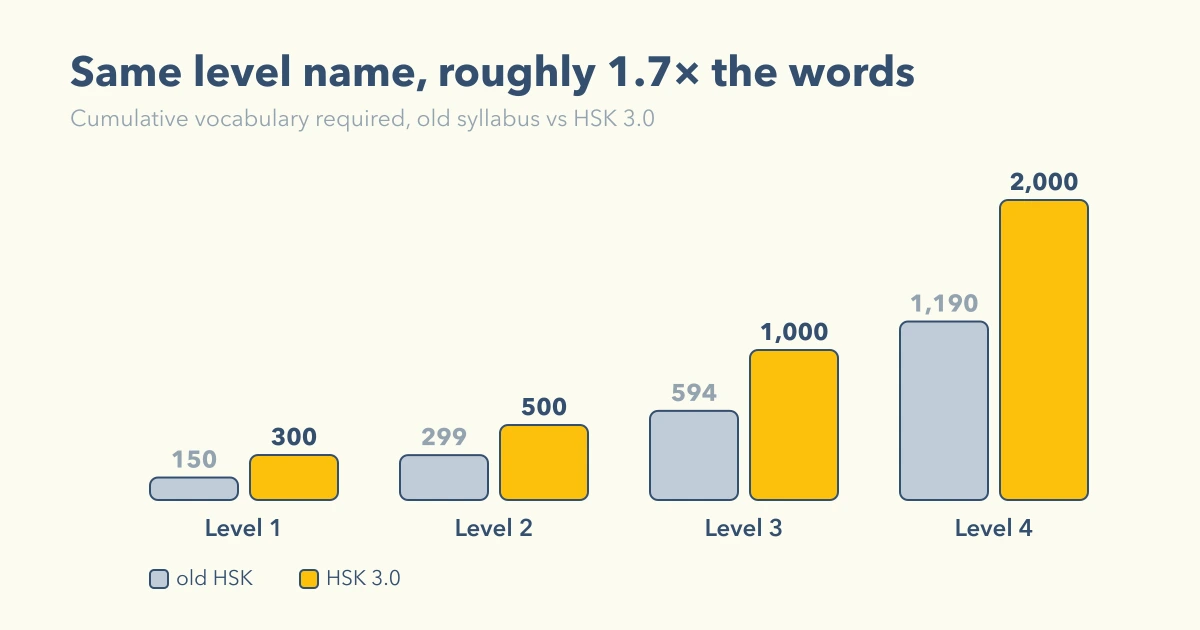
84% of old HSK 4 words are still HSK 4 words. Your vocabulary is not obsolete and it has not been reclassified. The problem is the other axis: old HSK 4 asked for about 1,200 cumulative words; new HSK 4 asks for 2,000.
That is the real gap. You know the right words. There are simply 800 more of them at the same level name — and because the words you already have are the correct ones, self-testing feels reassuring right up until you meet a text and find that one word in five is missing.
The same shape holds at 2 and 3: same level number, roughly 1.7× the vocabulary.
What the mapping cannot tell you
Three limits, stated plainly.
Old HSK 5 is not in this data. The published old-syllabus level 5 list exists only as a scanned PDF with no text layer, so its 1,300 words have not been digitised. We would rather show a gap than invent a mapping — for something people use to judge exam readiness, a fabricated answer is worse than no answer. The 2.0 → 3.0 converter greys level 5 out and says why, for the same reason.
Vocabulary is not the whole exam. The new standard added speaking, translation and handwriting at defined levels. A word-for-word mapping says nothing about skills the old written exam never tested.
Level names are not achievement. Recognising a word on a list and producing it in a sentence are different abilities. The mapping tells you which words changed address; it doesn't tell you which ones you can use.
Reading your own level across
Practical version, depending on where you were.
Old HSK 1–2 → new 1–2. Almost nothing moved up; some moved down. You are roughly where you were, with more words expected at each step.
Old HSK 3–4 → new 3–5. Your words are mostly still at their old level names, but each of those levels now demands close to double. Expect to be one band lower than the number suggests, purely on volume.
Old HSK 5–6 → new 6–9. A majority of your advanced vocabulary now counts as 7–9. This is the group most likely to undersell itself by assuming the reform inflated the scale.
The one check worth doing
None of this replaces a measurement. Take the free adaptive level test — about five minutes, scored on the new nine-level scale, and it reports which skill is dragging the number down rather than just the number.
Then check it against a list. If you land mid-scale, the HSK 3 vocabulary list is where the old-to-new gap opens widest: 1,000 cumulative words against the old 600, and old HSK 3 graduates routinely find a few hundred of them unfamiliar. Reading down it takes a few minutes and turns a rough mapping into something you can act on.