Chinese measure words: 161 exist, and you need about seven
2026-09-08 · 6 دقيقة قراءة
Measure words are the first thing in Chinese that feels arbitrary. You cannot say "three book" — you say 三本书, three volumes of book. Every countable noun demands one, and picking the wrong one is the most visible beginner mistake there is.
The usual advice is "just use 个 when in doubt". That works, and it is worth knowing how far it actually gets you, because the real distribution of these words is not what the panic suggests.
There are 161 of them, and you meet them slowly
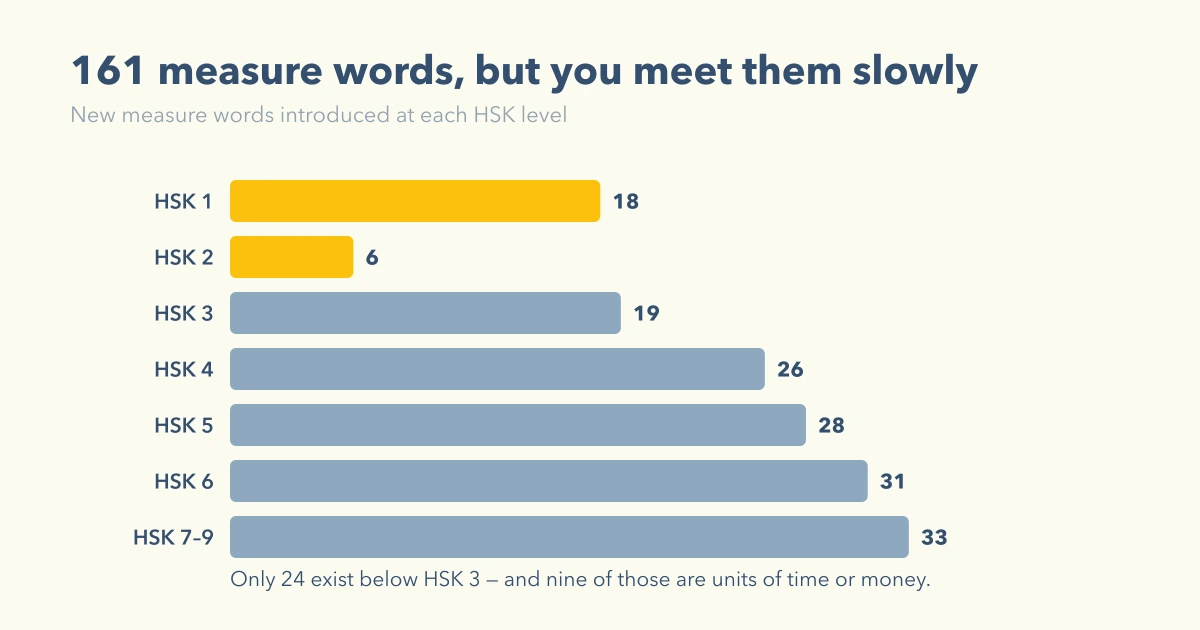
The HSK 3.0 syllabus tags 161 words as measure words. They are spread across all nine levels:
| Level | New measure words |
|---|---|
| HSK 1 | 18 |
| HSK 2 | 6 |
| HSK 3 | 19 |
| HSK 4 | 26 |
| HSK 5 | 28 |
| HSK 6 | 31 |
| HSK 7–9 | 33 |
A hundred and sixty-one sounds crushing. Twenty-four by the end of HSK 2 does not — that is the whole set you need to hold a basic conversation, and it arrives over months.
More usefully, look at what the early ones actually are.
The first twenty-four, and why most are not scary
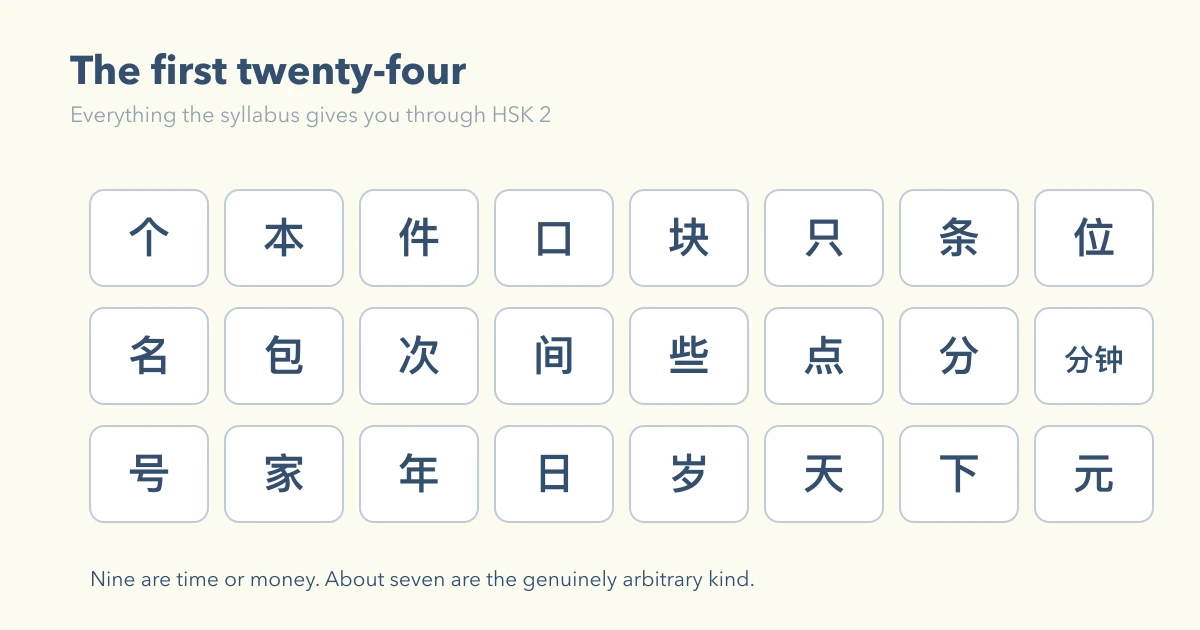
Here is everything the syllabus gives you through HSK 2:
个 本 件 口 块 只 条 位 名 包 次 间 些 点 分 分钟 号 家 年 日 岁 天 下 元
Sort that list by what kind of word it is and the panic drops sharply.
Units of time and money — nine of them. 分, 分钟, 号, 年, 日, 岁, 天, 元, 块. These are not really the puzzling kind. "Three minutes", "five years", "ten yuan" work the same way in English; nobody agonises over whether to say 三分钟.
Genuinely arbitrary shape-and-category words — about seven. 个 (general), 本 (bound volumes), 件 (clothing, affairs), 块 (chunks, and money), 只 (animals, one of a pair), 条 (long thin things), 张 (flat things — arrives at HSK 3).
People words — two. 位 (polite), 名 (formal/counting).
Everything else — 口, 包, 次, 间, 些, 下, 家 — is either narrow enough to learn with its noun, or so common you absorb it.
So the intimidating category, the one where you have to decide, is roughly seven words in the first year.
How far 个 actually gets you
Quite far, and it is worth being precise about the cost of leaning on it.
个 is the default classifier and it is grammatically acceptable with a very wide range of nouns. Using it where a more specific word exists is not an error that breaks comprehension — it is an error that marks you as a learner, in the same way "I have two informations" marks a non-native English speaker without confusing anyone.
That is the right trade early on. Fluency first, precision second. The failure mode to avoid is the opposite one: freezing mid-sentence to retrieve the correct classifier, which costs you far more than saying 个 would have.
The point at which it starts to matter is around HSK 3–4, when you begin writing rather than only speaking, and when the specific classifier starts carrying information rather than just satisfying grammar.
The ones that change the meaning
A handful of classifiers are not interchangeable decoration. They tell you something the noun does not:
- 一条鱼 is a fish — long, whole, alive or at least intact. 一块鱼 is a piece of fish, on a plate.
- 一只手 is one hand, of a pair. 一双手 is both.
- 一位老师 is respectful. 一个老师 is neutral, and in the wrong context slightly brusque.
- 一本书 is a physical volume. 一部书 is a work, a title.
These are the cases where using 个 does cost you something — not grammaticality, but precision. They are also few enough to learn as a short list rather than as a system, which is the practical point: the classifier system is large, but the part that carries meaning is small.
The set worth learning properly
If you learn seven precisely, learn these:
| Classifier | Used for | Example |
|---|---|---|
| 个 | the default, people, abstract things | 一个人 |
| 本 | bound volumes | 一本书 |
| 张 | flat things (HSK 3) | 一张纸 |
| 条 | long flexible things | 一条路 |
| 件 | clothing, matters, items | 一件事 |
| 只 | animals, one of a pair | 一只猫 |
| 位 | people, politely | 一位老师 |
Learn each with its noun, not as a list. 一本书 as a single chunk survives; "本 = volume" as an isolated fact does not, because at the moment you need it you are not thinking about volumes.
Why the count keeps rising after HSK 4
Two thirds of the 161 — 118 of them — arrive at HSK 4 and above. That is not the syllabus saving the hard ones for later out of cruelty. It is that most later classifiers are not really general-purpose grammar; they are domain vocabulary.
公斤, 米, 斤, 毛, 角 (HSK 3) are units. 遍, 层, 段, 封, 节, 句, 刻, 辆, 声, 双, 页, 种 (also HSK 3) each belong to a specific kind of noun and are learned with it. By HSK 6 you are meeting classifiers that appear in a handful of collocations and nowhere else — the same one-word problem that affects rare characters.
Which means the honest study rule is: the first two dozen are grammar and deserve deliberate practice. The rest are vocabulary and should be learned exactly the way you learn any other word — inside the phrase it lives in.
Three practical rules
Say 个 rather than pausing. A wrong classifier is a small error. A three-second silence in the middle of a noun phrase is a bigger one.
Learn the noun and its classifier as one unit. 一件衣服, 一辆车, 一条河. Never the classifier alone.
Do not pre-learn the list. Meeting 辆 for the first time in 一辆车 costs almost nothing. Learning all 161 up front costs weeks and most of them will not appear for a year.
A note on 些 and 点
Two of the HSK 1–2 entries are not really classifiers in the counting sense, and they confuse people who try to file them with 个 and 本.
一些 means "some" — an unspecified plural. 一点 means "a little" — an unspecified small amount. Neither takes a number other than 一, and neither answers "how many". They behave like quantifiers in English rather than like measure words, and trying to slot them into the 三本书 pattern produces sentences that are wrong in a way learners find hard to diagnose.
Learn them as the words some and a bit, not as members of the classifier set, and the confusion disappears.
You can browse the whole set, level by level, in the HSK vocabulary lists — each entry tagged with its part of speech, so the classifiers are easy to pick out.