
What does a good HSK writing answer actually look like?
2026-08-27 · 8 мин чтения
Writing is the part of the exam most learners prepare last and understand least. Reading and listening give you feedback. You were right or you were not. Writing gives you a number, weeks later, with no explanation attached.
So here is what the difference between a weak answer and a strong one actually looks like, in sentences you can compare side by side. Every example below is written for this article; nothing here is taken from a real paper.
The short version
- At lower levels you are graded on whether the sentence works, not on whether it is interesting.
- Most lost marks come from structure and connectors, not from missing vocabulary.
- A strong answer reuses a narrow set of patterns confidently rather than reaching for rare words.
- Length in Chinese tasks is counted in characters, and learners routinely misjudge it.
- Handwriting legibility is worth real marks once handwritten tasks enter the picture.
Level 4: the sentence has to carry its own weight
At this stage you are typically given a word and asked to build a sentence around it. The bar is correctness and naturalness: a sentence a native speaker would actually say.
Take the word 坚持 (to persist).
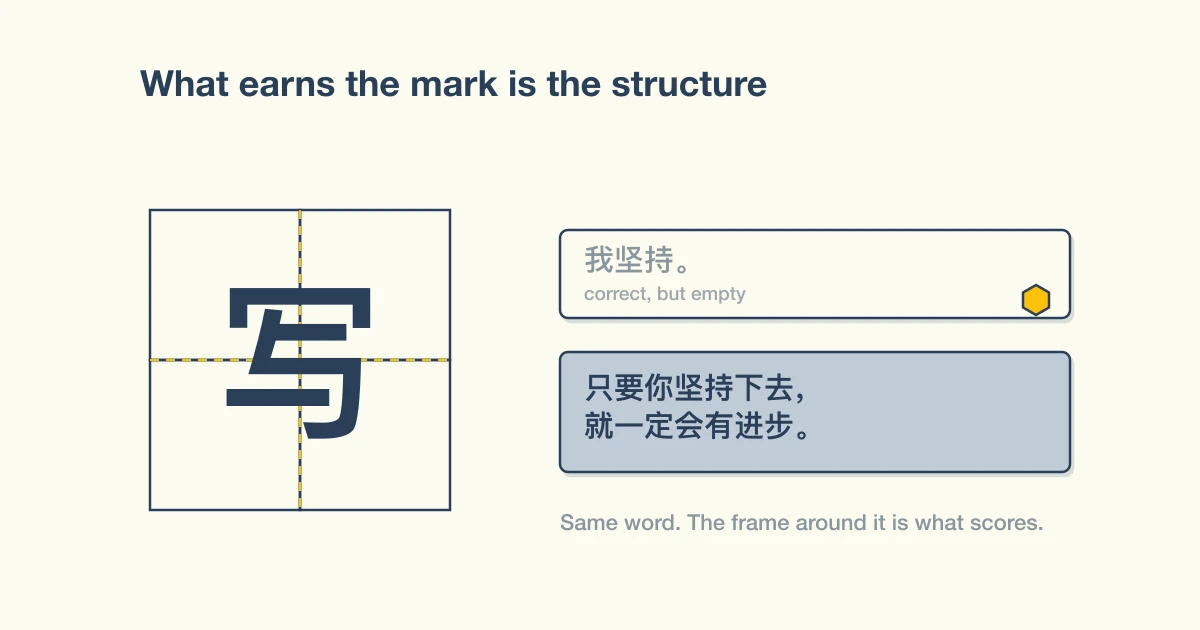
Weak: 我坚持。 It's grammatical. It's also empty. There is no context, so nothing shows that you know how the word behaves.
Better: 只要你坚持下去,就一定会有进步。 (As long as you keep at it, you will definitely improve.)
What earns the mark is not the vocabulary. It is that 坚持 is placed inside a 只要…就… frame and followed by 下去, which is exactly how the word is used. You have shown the examiner the word's grammar, not just its meaning.
Another, with 顺便 (in passing, while you are at it):
Weak: 我顺便去超市。 Better: 你去超市的时候,顺便帮我买一瓶酱油。 (When you go to the supermarket, pick me up a bottle of soy sauce while you are there.)
The second sentence establishes the main action first, which is what 顺便 requires. The first leaves the reader wondering: in passing from what?
The pattern to take away: at level 4, give every target word a context that proves you know when to use it. One clause of setup is usually enough.
Level 5: paragraphs need joins, not just sentences
Once you are producing several sentences together, the marks move to how they connect. This is where most learners quietly lose points, and it has nothing to do with how many words they know.
Compare these two versions of the same content.
Weak: 我每天学习中文。我觉得很难。我不想放弃。我想通过考试。
Four correct sentences. No relationship between them. It reads like a list, because it is one.
Better: 我每天都学习中文,虽然觉得很难,但是并不想放弃。因为我希望明年能通过考试,所以再累也会坚持下去。
Same ideas, same vocabulary level. The difference is 虽然…但是, 因为…所以, 再…也. Three connectors doing the work of showing that these thoughts are related.
Notice something about the second version: it does not use a single word that the first version did not. The upgrade cost zero new vocabulary. That's why connectors are the highest-return thing you can drill for writing.
Level 6 and above: position, then support
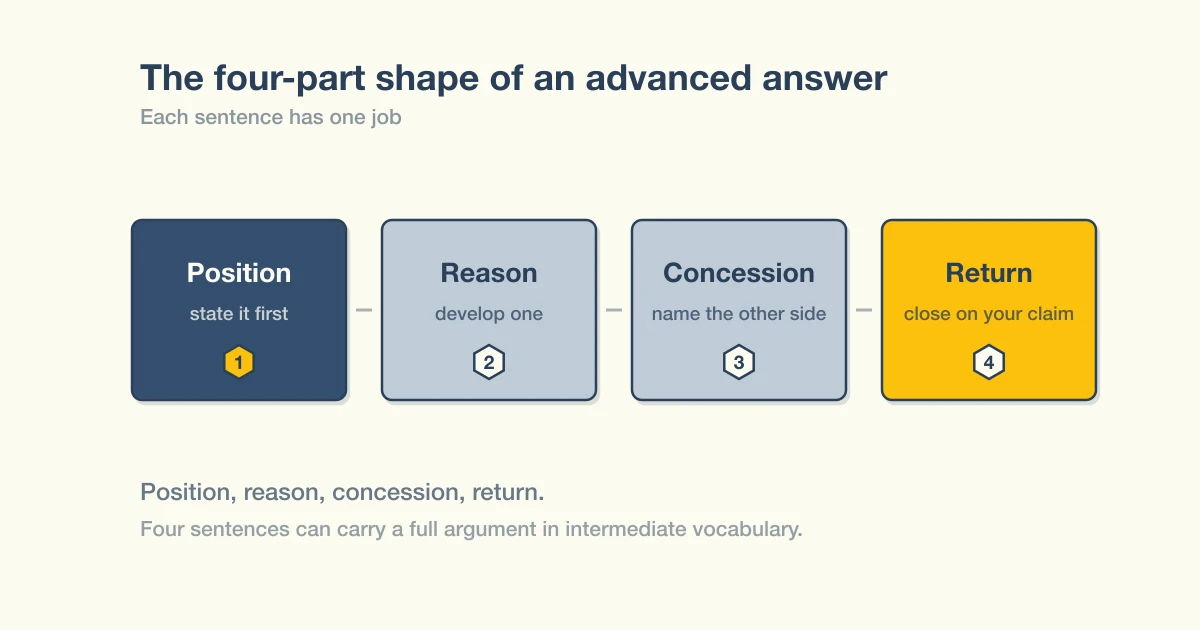
At the advanced levels you are expected to hold a position across a whole piece. The structure that reliably works is unglamorous and effective:
- State the position in the first sentence.
- Give one reason, developed.
- Acknowledge the opposing view briefly.
- Return to your position.
An original opening in that shape:
随着网络课程越来越普及,有人认为传统课堂已经没有必要了。我并不这么看。课堂真正的价值不在于传授知识,而在于人与人之间的直接交流——学生可以随时提问,老师也能立刻发现他们的困惑。当然,网络课程在时间和费用上确实更有优势,但它很难取代面对面的互动。
Four sentences, and every one has a job. Position, reason, concession, return. The vocabulary is solidly intermediate (普及, 传授, 困惑 are the hardest words in it), but the argument is fully formed.
That is the trade advanced writers get wrong most often. They reach for rare vocabulary and lose the thread of the argument. A clear argument in level 5 vocabulary scores better than a confused one in level 7 vocabulary.
The mistakes that cost marks quietly
Writing to a word count instead of a character count. Chinese length limits are given in characters. A task asking for 300字 wants 300 characters, which is far shorter than a 300-word English essay. If you're unsure how long your draft is, run it through the character counter. It also shows how many of those characters are distinct, which is a quick check on whether you are repeating yourself.
Recycling one connector: some learners discover 因为…所以 and use it six times. Three different connectors used once each read far better than one used three times.
Illegible handwriting: once handwritten tasks are in play, a character an examiner cannot read is a character you did not write. If you've been typing exclusively, this is a real and fixable risk, and how to practise writing characters covers what actually builds legible output.
Translating from English: sentences built on English word order survive at level 4 and fall apart at level 6. If your draft has a lot of 的 and long pre-noun modifiers, you're probably translating rather than composing.
How to practise when nobody is marking your work
The hard part of writing practice is the feedback loop. Three approaches that work without a teacher:
Rewrite your own weak paragraph. Write four short sentences on any topic, then rewrite them joined with connectors. You already know whether the second version is better. That's the point. Do this ten times and connectors stop being something you remember and start being something you reach for.
Keep a connector list of five. Not fifty. Five, used until automatic. 虽然…但是, 因为…所以, 不但…而且, 只要…就, 无论…都 will carry you a long way. Add more once these are reflexive.
Get the draft marked. If you want the loop closed properly, AI feedback on your writing will tell you which sentences read as translated and where the structure sags. That is the part self-review cannot do. You cannot see your own blind spots by definition.
Frequently asked questions
What does an HSK 4 writing answer need to include?
A complete sentence that shows how the target word behaves, not just what it means. Adding one clause of context (a 只要…就 frame, a time phrase, a reason) is usually enough to turn a bare correct sentence into a strong one.
How long should an HSK writing answer be?
Length is specified in characters, not words, and Chinese characters carry more meaning each than English words. A 300字 task is far shorter than a 300-word English essay. Draft it, count it, then adjust rather than guessing.
Do I lose marks for simple vocabulary in HSK writing?
Not if the writing is clear and well connected. A well-structured argument using intermediate vocabulary scores better than a confused one using rare words. Connectors and sentence structure carry more weight than vocabulary level at every stage.
How can I practise HSK writing without a teacher?
Write four short sentences, then rewrite them joined with connectors. You can judge the improvement yourself. For the parts you cannot see, such as English-influenced word order, automated feedback on a full draft closes the loop.
One concrete step, today
Write four short sentences about your day. Plain ones, the kind in the "weak" example above: no connectors, nothing clever.
Then rewrite them as one or two sentences using 虽然…但是 and 因为…所以. Do not add any new vocabulary; use only words already in your four sentences.
Compare the two versions. That gap is most of what separates a mid-band writing score from a good one, and you just closed it without learning a single new word. If you want the same paragraph marked properly, AI writing feedback points at the specific sentences that read as translated. If you are not sure which level you should be writing at, the free level test takes about five minutes.
Готовы начать?
Определите свой уровень HSK 3.0 за 5 минут — бесплатно и без карты.
Пройти тест на уровень