
What is actually on the HSK 1 test
2026-09-08 · 6 мин чтения
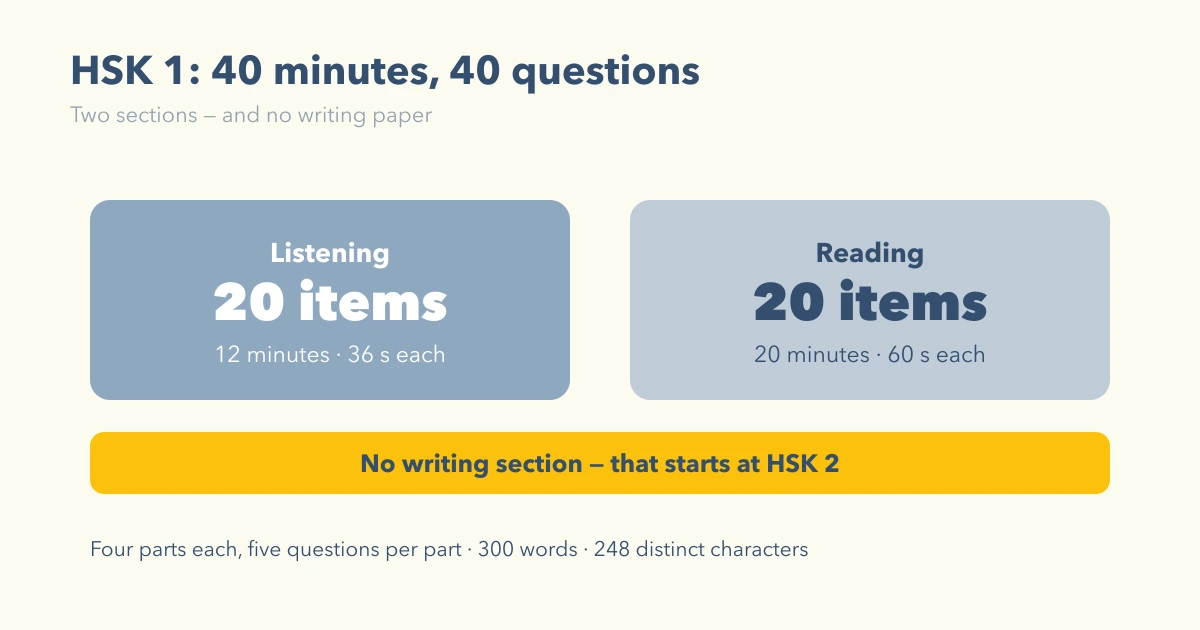
HSK 1 is the shortest exam in the series and the one people most often over-prepare for. Forty minutes, forty questions, and a structure that has not changed shape under HSK 3.0 even though the vocabulary around it has.
Here is exactly what the paper contains.
The shape: 40 minutes, 40 items, two sections
| Section | Minutes | Questions |
|---|---|---|
| Listening | 12 | 20 |
| Reading | 20 | 20 |
There is no writing section at HSK 1. Writing enters at HSK 2, and handwriting proper is a later concern still. If you are practising characters by hand for HSK 1, you are practising for the next exam, not this one.
The eight remaining minutes are transfer and administration time.
Listening: four parts, five questions each
| Part | Task | Options |
|---|---|---|
| 1 | Hear a phrase, choose the matching picture | 3 |
| 2 | Hear a question, choose the right response | 3 |
| 3 | Hear a short dialogue, match it to a picture | 6 |
| 4 | Hear a statement and a question, choose the answer | 3 |
Three of the four parts are three-option multiple choice. Part 3 is the outlier — six pictures for five dialogues, so one is a distractor and you cannot recover a wrong answer by elimination as easily.
Twelve minutes for twenty items means roughly 35 seconds per question, including the audio. That is not a lot of thinking time, and it is the single most common reason a candidate who "knew the words" scores badly.
Reading: four parts, five questions each
| Part | Task | Options |
|---|---|---|
| 1 | Read a sentence, match it to a picture | 6 |
| 2 | Match a question to its response | 6 |
| 3 | Fill a blank from a shared word bank | 6 |
| 4 | Read a prompt, choose the answer | 3 |
Part 3 is the one that catches people. A shared word bank means the options are pooled across all five questions — get one wrong and you have almost certainly got a second one wrong too, because the word you misused was needed somewhere else. It is the only part of HSK 1 where errors are correlated rather than independent.
Twenty minutes for twenty reading items is a full minute each, which is generous. Reading is not where HSK 1 candidates run out of time.
What HSK 1 asks for in vocabulary
300 words. That is the entire HSK 1 list, and it is the smallest step in the whole sequence — HSK 2 adds only 200 more, the only place where a level asks for less than the one before it.
Those 300 words use 248 distinct characters, which between them cover about 49% of the character tokens in level-appropriate sentences. Half of everything you see will be familiar; the other half is what the three-option format is there to help you around.
How the exam changes above HSK 1
Worth seeing early, because it explains what you are actually preparing for:
| Level | Minutes | Items | Sections |
|---|---|---|---|
| 1 | 40 | 40 | listening, reading |
| 2 | 60 | 60 | + writing |
| 3 | 83 | 70 | |
| 4 | 85 | 70 | |
| 5 | 110 | 72 | |
| 6 | 125 | 82 | |
| 7–9 | 210 | 91 | + translation |
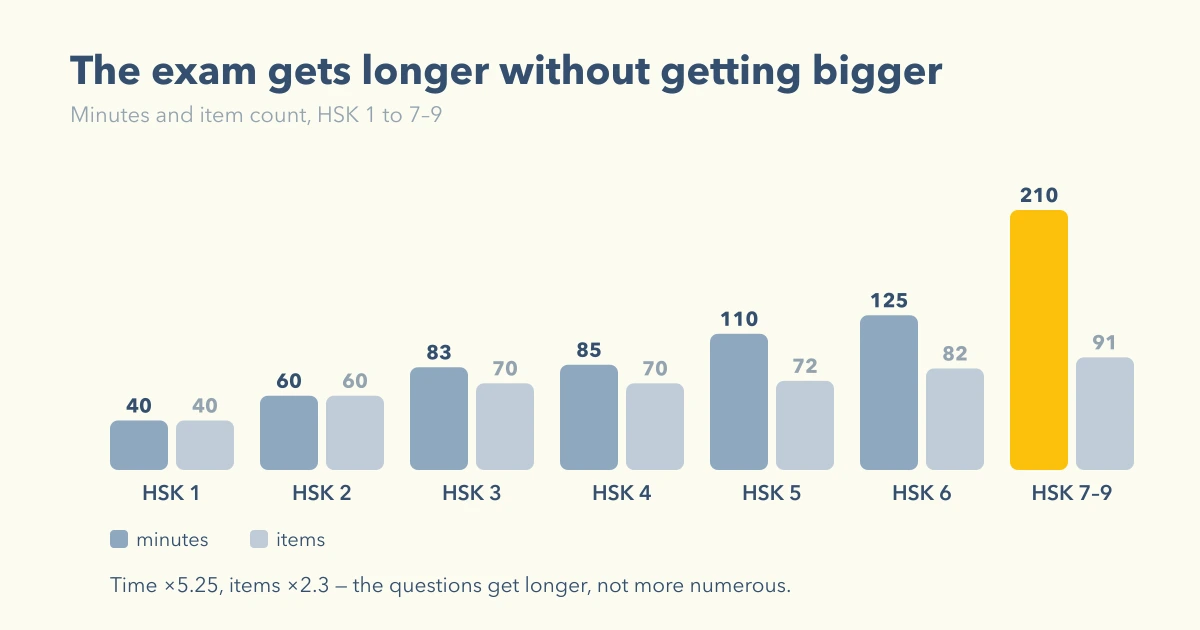
Item count barely more than doubles from HSK 1 to HSK 7–9 — 40 to 91 — while time more than quintuples. The exam is not getting longer by adding questions; it is getting longer because the questions get longer. HSK 5 gives you 40 minutes for two writing items. HSK 1 gives you 12 minutes for twenty listening items.
That is the real trajectory: from many fast recognitions to few slow productions. Preparation that works at HSK 1 — drilling recognition speed — stops being the main thing somewhere around HSK 4.
What the format tells you about preparation
Three of HSK 1's eight parts are matching tasks with six options for five items. That structure rewards a specific tactic: place the ones you are certain of first, then use elimination on the rest. The single leftover distractor means elimination is genuinely informative in a way it is not in three-option parts.
Three parts are three-option multiple choice, where a guess has a one-in-three floor. An unanswered item scores nothing, so leaving one blank is strictly worse than guessing it.
Preparing for the paper you are actually sitting
Practise listening under time pressure, not at your own pace. Thirty-five seconds per item is the constraint. Vocabulary you can retrieve in three seconds is not vocabulary you have for this exam.
Do not neglect the picture-matching format. It sounds trivial and it is where careless marks go, because the pictures are deliberately similar and the audio is short.
Treat the word-bank part as a set, not five questions. Read all five sentences before placing anything, then assign the words that only fit one slot first.
Skip handwriting practice for this exam. There is no writing section. Spend the time on listening speed.
HSK 1 against HSK 2, in numbers
Useful for deciding which to sit, since many candidates are between the two:
| HSK 1 | HSK 2 | |
|---|---|---|
| Minutes | 40 | 60 |
| Items | 40 | 60 |
| Cumulative words | 300 | 500 |
| Sections | listening, reading | + writing |
| Listening seconds per item | 36 | 41 |
HSK 2 adds a third section and 200 words, and gives you slightly more time per listening item. The step is real but modest — much smaller than the HSK 2 to HSK 3 step, where listening passages more than double in length.
If you are comfortably through the HSK 1 list and roughly half way through HSK 2, sitting HSK 2 is usually the better use of an exam fee than sitting HSK 1 first. The certificates are not cumulative in any way that requires you to collect them in order.
Before you book
The most useful pre-check is not another practice paper — it is finding out whether 300 words is where you actually are. Read down the HSK 1 vocabulary list and mark what you cannot produce in a sentence, or sit the free adaptive placement test for a five-minute estimate. If HSK 1 is comfortably behind you, sitting it proves nothing you did not already know.
Готовы начать?
Определите свой уровень HSK 3.0 за 5 минут — бесплатно и без карты.
Пройти тест на уровень