
Which Chinese radicals are actually worth learning
2026-09-08 · 6 мин чтения
Most radical guides hand you a table of 214 and wish you luck. That table is a dictionary index, not a study list, and treating it as one is why people abandon radicals in week two.
The useful question is which radicals pay. That has a numeric answer, and the distribution is far more lopsided than anyone tells you.
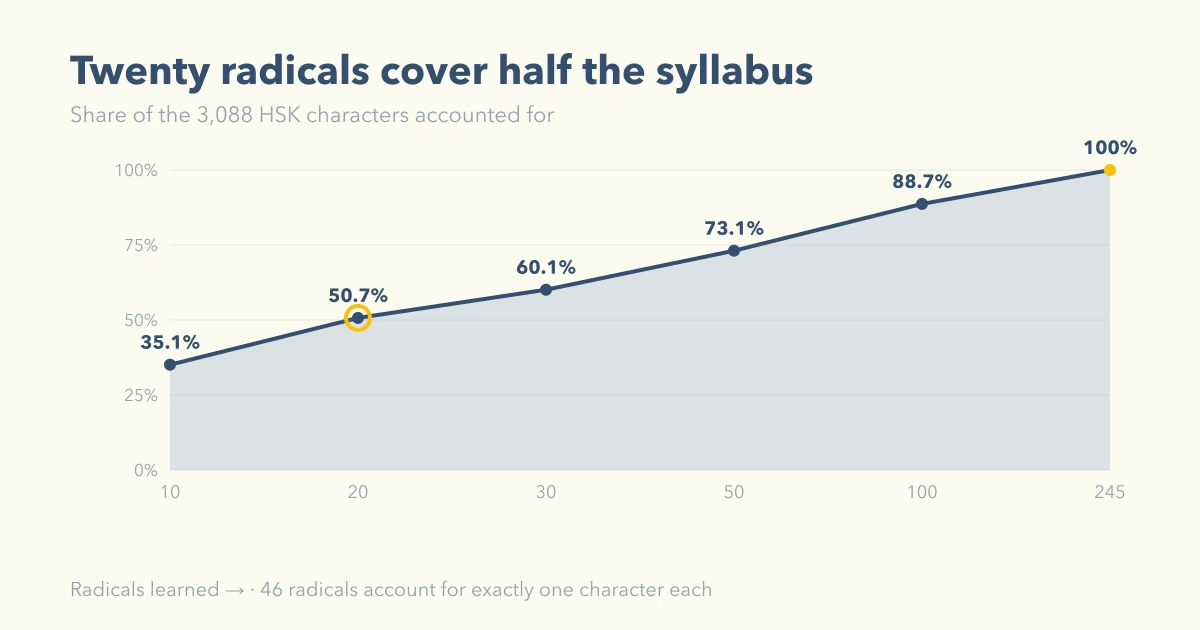
Twenty radicals cover half the syllabus
Every one of the 3,088 characters in the HSK 3.0 word list has a radical assigned. Count how many characters each radical accounts for, sort, and add up:
| Radicals learned | Share of syllabus characters |
|---|---|
| 10 | 35.1% |
| 20 | 50.7% |
| 30 | 60.1% |
| 50 | 73.1% |
| 100 | 88.7% |
| all 245 | 100% |
Ten radicals get you a third. Twenty get you half. The remaining 145 split the last quarter between them, and at the tail end 46 radicals account for exactly one character each — an entire category you can learn on sight when you meet it, if ever.
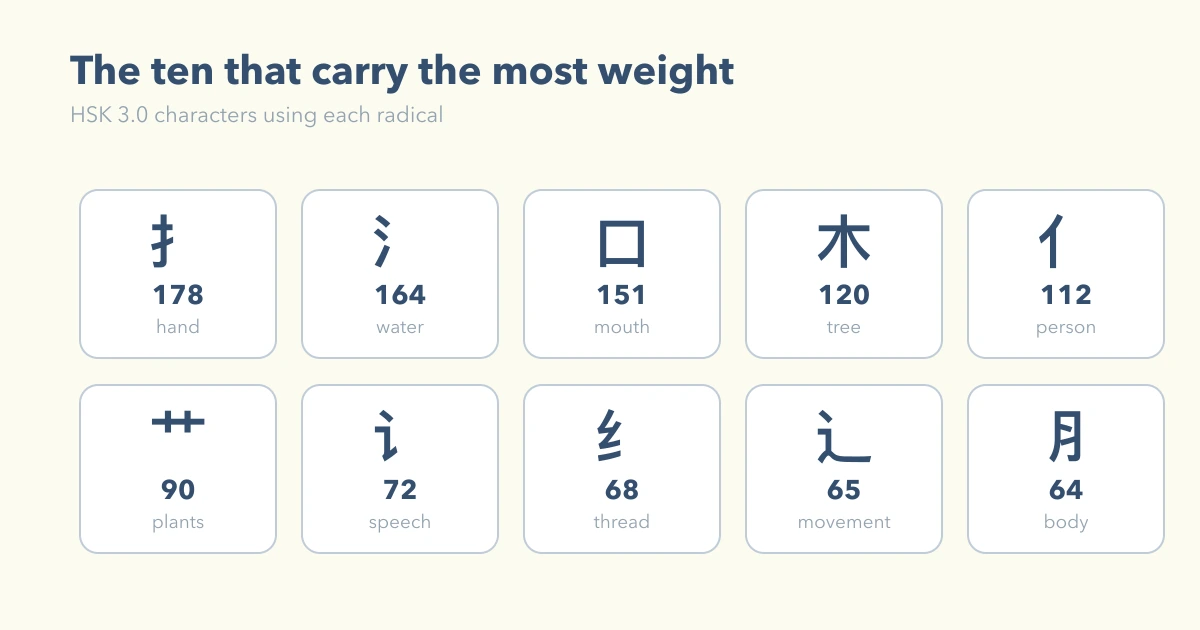
Here are the ten that carry the most weight, with how many syllabus characters each covers:
| Radical | Characters | Meaning |
|---|---|---|
| 扌 | 178 | hand (action done with hands) |
| 氵 | 164 | water |
| 口 | 151 | mouth |
| 木 | 120 | tree, wood |
| 亻 | 112 | person |
| 艹 | 90 | grass, plants |
| 讠 | 72 | speech |
| 纟 | 68 | silk, thread |
| 辶 | 65 | movement, walking |
| ⺼ | 64 | flesh, body part |
Nothing exotic. Hand, water, mouth, tree, person — the categories a writing system invented for farming and administration would obviously need most.
What a radical actually buys you
Not the meaning. This is where the promise usually oversells.
扌 tells you a character is probably an action done with the hands. It does not tell you which: 打 (hit), 拿 (take), 找 (look for), 抱 (hug), 换 (exchange) all carry it. Knowing the radical narrows 178 candidates to a semantic neighbourhood. It does not deliver an answer.
What it does buy, reliably, is three things:
A hook for memory. A character with a category attached is far easier to hold than an arbitrary shape. 河, 湖, 海, 洋, 洗, 游 — all water — form a set rather than six unrelated blobs.
A guess that is usually not embarrassing. Meeting 抬 for the first time, "something you do with your hands" is enough to follow a sentence.
A way to look things up. This was radicals' original job, and it still works when you cannot type a character you can see. Our radical table is built for exactly that: find the component you recognise, get the characters that use it.
The three that behave differently
Two entries on the top-ten list deserve a warning, and one deserves a promotion.
⺼ is not the moon. The flesh radical (64 characters — 脸, 胃, 腿, 肚) is printed identically to 月 (moon) in most fonts. If a character is a body part, it is the flesh radical regardless of what it looks like. This single collision causes more confusion than any other in the set.
辶 is not a component you can see coming. It wraps around the bottom-left of whatever it contains, so 这, 过, 还, 送 look structurally unlike the left-right characters that make up most of the syllabus. Worth learning early precisely because it is visually distinctive.
讠 is the highest-yield one nobody teaches first. 72 characters, all about speech or language — 说, 话, 谁, 语, 谢, 请, 认, 记. Because those verbs are common, its 72 characters carry more text than their count suggests.
Looking up a character you cannot type
This is radicals' original job and the one place they are indispensable. You see a character — on a sign, in a handwritten note, in a photo — and you have no way to type it because you do not know its pronunciation.
The procedure: identify the component you recognise, usually on the left or the top. Look it up in a radical index. Scan the characters filed under it until you find yours. With twenty radicals known, you can do this for roughly half the syllabus without knowing a single reading.
That is a genuinely useful capability and it is entirely separate from the "radicals reveal meaning" claim. It works whether or not the radical tells you anything semantic, because it is an indexing scheme, not a decoding one.
The half of the character nobody mentions
Most Chinese characters are compounds of two parts: one hinting at meaning (the radical) and one hinting at sound. 妈 is 女 (woman) plus 马 (mǎ) — and it is pronounced mā. 河 is 氵 (water) plus 可 (kě) — pronounced hé.
The sound hints are real and they are unreliable. Two thousand years of pronunciation drift means the phonetic component often points at a syllable that no longer matches, or matches only in tone-less shape. 河 from 可 is a hint, not a rule.
For a beginner the practical advice is to ignore this half. For someone past HSK 5 it becomes worth noticing, because by then you know enough characters for the pattern to be visible, and a 60%-reliable guess at pronunciation is worth having when the alternative is none.
How to actually learn them
Learn twenty, then stop. You are at 50% coverage. The twenty-first radical buys under half a percent, and by radical 100 you are buying hundredths. There is no point at which grinding the full table becomes a good use of an hour.
Learn them from characters, not from a table. A radical memorised in isolation is a shape with a gloss. A radical met across 河, 洗, 海 is a pattern you noticed, and noticed patterns survive.
Do not expect them to decode meaning. They narrow the field. Anyone promising that radicals let you "read characters you have never seen" is selling the 20% case as the rule.
Ignore the sound half unless you are past HSK 5. Most characters also carry a phonetic component hinting at pronunciation, but the hints have eroded over two millennia and are unreliable enough that beginners should not be counting on them.
The honest summary
Radicals are worth about two hours of your life, spent on twenty of them, learned from characters you already meet. That buys a memory hook on half the syllabus and a way to look up anything you can see but cannot type.
What they are not is a decoder ring. The characters that will actually cost you are not the ones with unfamiliar radicals — they are the ones built from identical components, where the radical tells you nothing because both characters have the same one.
Готовы начать?
Определите свой уровень HSK 3.0 за 5 минут — бесплатно и без карты.
Пройти тест на уровень